Texas Explained
Texas Loops and Spurs Explained: What the Signs Actually Mean
In Texas, Loop and Spur are official highway-system designations, not literal promises about road shape. Loops commonly grew from bypasses; Spurs are branch routes. Here is how to read them, why famous examples no longer match the simple definitions, and what the signs tell you on a road trip.
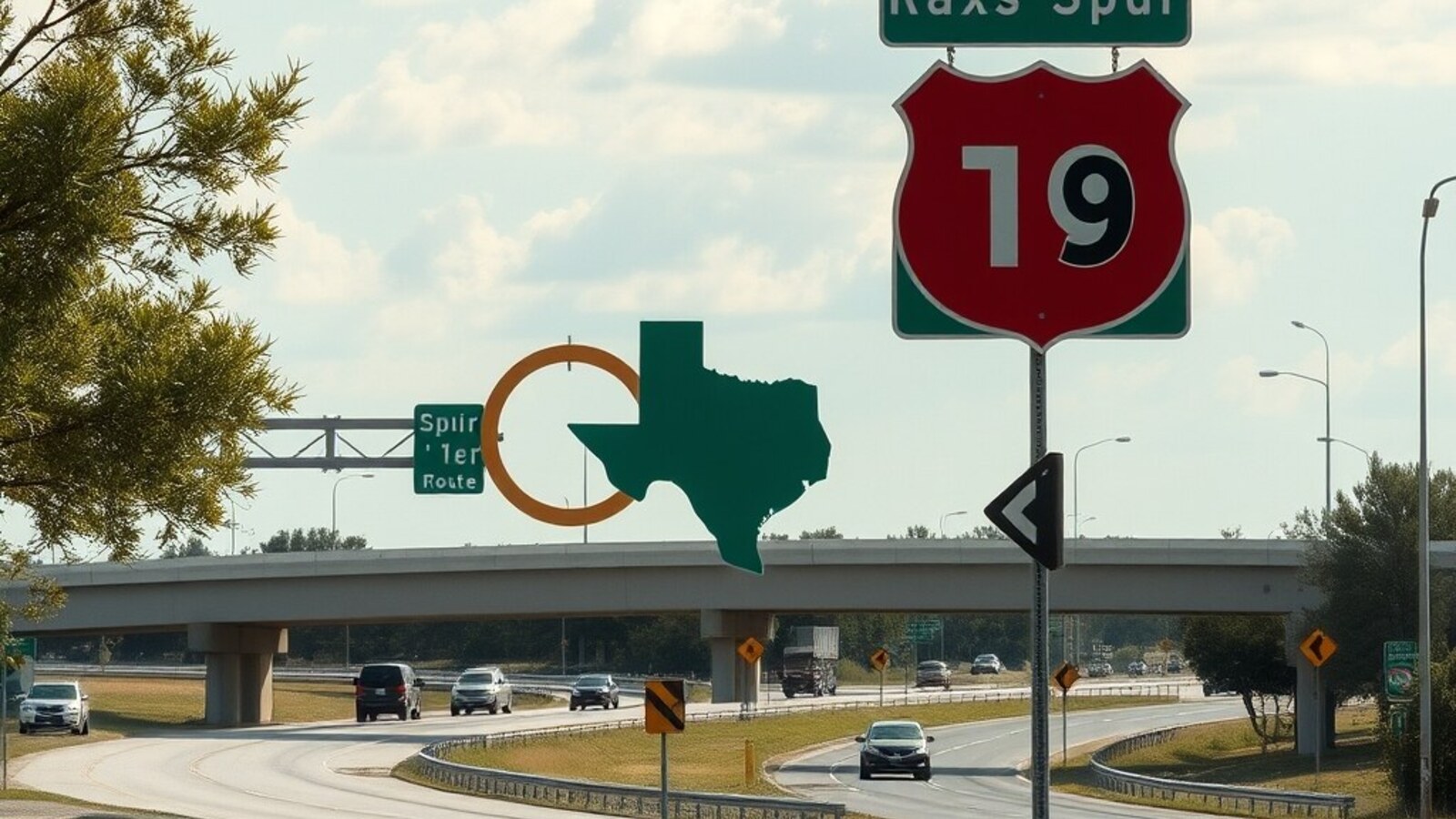
A Texas Loop usually carries traffic around a place and reconnects with the highway network. A Spur usually branches away to a local road or destination. Neither name guarantees what the road looks like today.
Loop
Typically connects with another state highway at both ends. It does not have to make a complete circle.
Spur
Typically branches from a state highway and ends on an off-system road rather than returning to the parent corridor.
The shortest useful answer is this: in Texas, Loop and Spur are names for route types inside the state highway system. A Loop is commonly associated with a bypassing or reconnecting route. A Spur is commonly a branch route that leaves another highway and ends at a local road, district or destination. But the name on the shield describes the route's administrative role more reliably than its modern geometry.
Loop vs. Spur at a glance
- Loop: usually a bypass or reconnecting route; it does not have to form a complete circle.
- Spur: usually a branch from another highway toward a destination or off-system road; it generally does not return.
- Both are formal route designations approved through the Texas transportation process.
- The designation can survive for decades even after growth changes what the road looks like and how drivers use it.
- The route number is an identity in the highway network, not a guarantee that the pavement still matches the original purpose.
What TxDOT means by a State Highway Loop
TxDOT's highway-designation system treats a State Highway Loop as a designated roadway, commonly associated with bypassing or routing traffic around a place. Proposed changes to the state highway system—including new designations, changes and deletions—go through the Texas Transportation Commission. TxDOT assigns the route number and prepares the designation action for commission approval.
That administrative history matters because a road can stop looking like a bypass while remaining a Loop. Development may grow around it, interchanges may replace signals, frontage roads may appear, and a once-edge-of-town route may become one of the busiest corridors in a metro area.
Why a Texas Loop does not have to be a circle
Everyday language makes 'loop' sound geometric: leave a point, curve around and come back. Texas highway naming is less literal. Some Loops reconnect with the broader highway system without drawing a neat circle. Others have been extended, rebuilt or absorbed into a larger urban network. The shield tells you the route's designated system identity, not whether the line on today's map looks like a ring.
Loop 1604: the clearest modern example
San Antonio's Loop 1604 shows why the designation should not be read too literally. TxDOT currently treats Loop 1604 as a major metropolitan corridor, with multi-segment expansion projects between SH 16, I-10, US 281 and I-35. For a driver, it functions as a high-capacity outer route around large parts of the San Antonio region. Its scale is far beyond the mental picture of a short bypass around a small downtown.
Loop 410: a Loop that became an Interstate
San Antonio offers another useful lesson. The corridor long known locally as Loop 410 is now signed as I-410 on the Interstate system. TxDOT's current project pages use I-410 because the route's present federal system identity matters for navigation and project naming. The familiar '410 loop' language survives culturally even though the official route is Interstate 410.
What TxDOT means by a State Highway Spur
A State Highway Spur is the branch-route idea. TxDOT describes a Spur as a roadway that usually begins on a state highway and ends on an off-system roadway. That makes a Spur useful for preserving a state-system connection to a local street, district, facility or destination without treating the branch as a longer through route.
Why Spurs exist
- To keep a short connector in the state highway system.
- To reach a downtown, industrial area, port, airport, military facility or other destination from a larger corridor.
- To preserve an older piece of a highway after the main route is relocated.
- To identify a branch that is operationally important but does not function as a through highway.
- To make the relationship between the branch and the larger state network explicit.
Loops, Spurs and Business Routes are not interchangeable
These route types can look similar on a map, but they describe different network relationships. A Loop commonly reflects bypassing or reconnecting movement. A Spur is a branch. A Business Route usually follows a local alignment connected to a parent through route, often preserving access through the commercial center after a bypass opens. Reading the route type tells you what relationship to look for.
How bypasses created many of these roads
Texas highway building after World War II repeatedly moved through traffic away from congested town centers. A new route around town could become a Loop, while an older or shorter connector could remain as a Spur or Business Route depending on its relationship to the parent highway. As towns expanded outward, the bypass itself often attracted motels, service stations, shopping centers, subdivisions and later freeway-style development.
Why yesterday's bypass becomes today's main road
Roads shape development. A bypass starts with open land because it is built outside the congested core. Then access and traffic make that land valuable. Businesses follow, housing follows, intersections multiply and the edge of town moves farther outward. Decades later the old bypass can sit in the middle of continuous urban development while retaining the Loop number that records its earlier role.
How to read Loop and Spur signs while traveling
- Use the route number and shield as the primary navigation identity.
- Do not assume Loop means a full beltway or ring road.
- Do not assume Spur means an unimportant road; some serve major destinations and carry heavy traffic.
- If you are trying to reach an older downtown, compare the Loop or bypass with any Business Route or local main-street alignment.
- When a familiar local name conflicts with current signs, current route shields and official TxDOT mapping are the better navigation guide.
Loop, beltway and bypass: related words, not synonyms
A beltway usually describes a road's function or shape around a metropolitan area. A bypass describes the job of carrying through traffic around a congested place. Loop is an official Texas route-system designation. One road can fit more than one of those ideas in ordinary conversation, but the words are not administratively interchangeable. Houston's Beltway 8, for example, is a beltway by name and function, but that does not make every Texas Loop a beltway.
Why the numbering can feel random
Loop and Spur numbers are route identifiers assigned within the highway-designation process. They are not a mileage code, a county code or a promise that a same-numbered State Highway exists nearby. The safest way to interpret the number is simply as the route's official identifier within the system.
What the designation tells you—and what it does not
- It tells you the route belongs to a defined highway-system category.
- It can preserve the route's historical network role even after surrounding land use changes.
- It does not guarantee the route is circular, rural, lightly traveled or short.
- It does not by itself tell you whether the road is freeway-standard, signalized, tolled or locally known by another name.
- It does not replace the need to check current signs and official maps for navigation.
Frequently asked questions about Texas Loops and Spurs
Is every Texas Loop actually a loop?
No. The designation is not a geometric test. A Texas Loop may function as a bypass or reconnecting route without forming a complete circle.
What is the difference between a Loop and a beltway?
Loop is an official route designation in the Texas highway system. Beltway is a descriptive term for a road that circles or partly circles a metropolitan area. A road can be called a beltway without being designated as a State Highway Loop.
What is the difference between a Loop and a Business Route?
A Loop is commonly tied to bypassing or routing around a place. A Business Route usually serves the local or older alignment of a parent highway, often carrying drivers through the commercial center while the main highway bypasses it.
Does a Spur always end?
A Spur generally functions as a branch and commonly ends at an off-system road or destination rather than reconnecting as a through route. The exact network context still matters, so current TxDOT mapping is the best source for a specific route.
Who creates or changes Texas Loop and Spur designations?
The Texas Transportation Commission approves state-highway-system designation actions. TxDOT develops the request, assigns an appropriate number and prepares the minute-order material for commission consideration.
Why do some Loops look like ordinary city streets?
Because the designation can outlive the landscape that created it. Urban growth can surround an old bypass, add traffic signals and development, or turn it into a major arterial while the route number remains.
Why do Loop 1604 and I-410 feel so different from small-town Loops?
Texas route designations persist while cities grow and highway standards change. Loop 1604 evolved into a major outer San Antonio corridor, while the route historically known as Loop 410 became part of the Interstate system as I-410. Their present scale reflects metropolitan growth, not a different meaning of the word 'loop.'
The road sign is a piece of history
The most useful way to read Loop and Spur is as a clue to how the network was organized. A Loop often points to the logic of bypassing or reconnecting traffic. A Spur points to a branch connection. When the modern road no longer looks like the definition, that mismatch is not a failure of the sign—it is evidence that Texas grew around the road.
Primary source: Texas Department of Transportation ↗
From the magazine
More stories to read next
Road Trips
Fredericksburg to Johnson City: The Complete Historic Hill Country Road Trip
October 12, 2026 · About 11 minutes