
60–90 minutes
Museum only
- Start with the student-walkout and Chicano-movement material
- Continue through the Crystal City Family Internment Camp exhibit
- Finish with Zavala County veterans and community-history displays
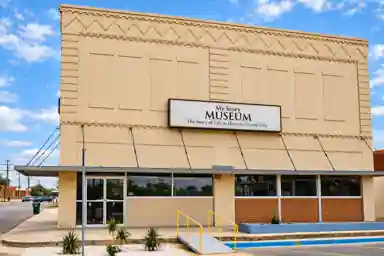
South Texas Plains · Historic Sites & Museums
My Story Museum is Crystal City's first permanent local-history museum, preserving Zavala County stories through exhibits on the 1969 student walkouts and Chicano movement, the Crystal City Family Internment Camp, and local military veterans.
Photography: AI-generated image · TexasDefined
Quick trip facts
The experience
My Story Museum is important because it puts several nationally significant chapters of South Texas history in the same local frame. Crystal City is widely known for spinach and Winter Garden agriculture, but the community also became a major site of Mexican American school activism and electoral organizing and, decades earlier, hosted the federal government's largest World War II family internment facility. The museum's permanent exhibits make those stories accessible through a community institution rather than leaving visitors to assemble the history from scattered markers and archives.
One exhibit focuses on the 1969 student walkouts and the wider Chicano movement in Zavala County. The walkout grew from long-running disputes over discrimination, representation and school policy. Texas State Historical Association accounts place the successful student boycott inside the larger Crystal City Revolts and the political organizing that helped produce the Raza Unida Party in 1970. For visitors, that means the museum is not simply documenting a school protest; it is interpreting a turning point in the political history of Mexican Americans in Texas.
A second major exhibit interprets the Crystal City Family Internment Camp. The Texas Historical Commission documents the camp as the only Immigration and Naturalization Service confinement camp created specifically to hold families together. From 1942 until 1948 it held thousands of people of Japanese, German and Italian nationality or ancestry, including people brought to the United States from Latin America. The former camp site still has a historical marker and eight-panel interpretive trail, so the museum and the physical site work best as companion stops rather than substitutes for one another.
The museum also preserves the experiences of Zavala County veterans. That local layer matters because it keeps the institution from becoming a two-topic exhibit hall. Military service, agricultural life, school activism, migration and wartime confinement all affected families in the same county, and a community museum can show those histories in relation to one another.
The Crystal City Pilgrimage Committee identifies My Story Museum as the city's first permanent history museum. Its Phase II expansion of the internment-camp exhibit opened during the 2025 Crystal City Pilgrimage, demonstrating that the museum is an active and evolving institution rather than an archival name for a closed local museum. Current visitor information identifies the institution as My Story Museum; older or ambiguous references to a 'Zavala County Museum' should not be treated as a separate operating museum.
The details
Evidence and citations
Read the original operator records and supporting research for this guide.
Current museum identity, exhibits, address, hours, admission, contact information and 2025 exhibit expansion.
Official history of the Crystal City Family Internment Camp, population, administration, closure and surviving interpretive trail.
Official marker record for the former camp, its scale, purpose, location and historical significance.
National Register documentation confirming the historic district and federally recognized significance of the former camp site.
Historical context for the 1969 student boycott, school demands and the political movement that followed.
Crystal City's role in the 1970 founding and early electoral success of the Raza Unida Party.
The visit
Texas context
My Story Museum is the strongest current public-history anchor for Crystal City because it connects three subjects rarely interpreted together in one place: Mexican American student and political activism, federal wartime family internment, and local veterans. Those stories make Crystal City significant far beyond its agricultural identity.
Use the time you have
60–90 minutes
2–3 hours
Half day
Before you go
Around the area
Use the museum as the indoor anchor for a Crystal City history day, then connect the exhibits to the county guide and the surviving places where the stories happened.
Easy additions that fit naturally around the main stop.
Crystal City and countywide
Put the museum inside the broader story of Crystal City, Winter Garden agriculture, the Nueces country, Mexican American political organizing and county history.
Crystal City
Visit the former confinement-site landscape, historical marker and interpretive panels after seeing the museum's internment exhibit.
Around the museum
Add the courthouse area, community landmarks and the civic core that shaped local political and agricultural history.
Dining districts and food areas worth building into the same outing.
In town
Use the downtown and U.S. 83 corridors for local food stops before or after the museum; the county guide provides context for the surrounding town.
The most practical lodging areas for minimizing driving and maximizing time on the ground.
In town and region
Crystal City is the most direct base for the museum and internment-camp site; Carrizo Springs and Uvalde can work for longer regional trips.
Nearby parts of the city that add character, shopping, history or nightlife.
Museum district
The compact civic center is the best place to connect the museum with the county's government, school, agricultural and political history.
Good nearby additions when the itinerary includes younger travelers.
On site
The museum is free and compact, but some internment and civil-rights material can prompt difficult questions; families may want to preview those topics for younger children.
Places that justify extending the visit beyond the immediate area.
North of Zavala County
Continue north on U.S. 83 to connect the Winter Garden with the Nueces and Leona country around Uvalde.
South of Crystal City
Continue south toward Carrizo Springs for another major piece of Winter Garden agricultural and South Texas history.
Plan the route
Editorially paired stops near My Story Museum appear first, followed by nearby destinations. Distances are approximate straight-line miles.
Cotulla · La Salle and Dimmit counties · South Texas Plains
Chaparral WMA protects 15,200 acres of South Texas brush country near Cotulla and serves as a major TPWD research, demonstration and public-use landscape for thornscrub wildlife and habitat management.
Approx. 35 miles away
Uvalde · Uvalde County
The Briscoe-Garner Museum in Uvalde occupies John Nance Garner's National Historic Landmark home and interprets the lives and political legacies of Vice President Garner and Texas Governor Dolph Briscoe through photographs, documents, artifacts and the historic residence itself.
Approx. 37 miles away
Cotulla · La Salle County · South Texas Plains
Cotulla's Brush Country Museum preserves La Salle County history in a former one-room school and adjoining historic property, with ranch-life photographs, domestic displays, local artifacts and interpretation of the segregated school system and Lyndon B. Johnson's early teaching years nearby.
Approx. 40 miles away
Pearsall · Frio County · South Texas Plains
Pearsall's Frio Pioneer Jail Museum occupies the 1884 Old Frio County Jail, preserving the sheriff's residence, original jail cells, county photographs and artifacts tied to ranching, drought, Prohibition and everyday life in early Frio County.
Approx. 47 miles away
Concan · Uvalde County
Frio River swimming, limestone hills, trails, cabins, and camping.
Approx. 63 miles away
Leakey · Real County
Leakey is the Real County seat and practical hub of the Frio Canyon, pairing a historic limestone courthouse with Frio River recreation, scenic Hill Country drives, nearby Garner State Park and access to the Lost Maples and Three Twisted Sisters landscape.
Approx. 73 miles away
Texas Explained
Go beyond the destination with the systems, landscapes and history that explain why this part of Texas looks and works the way it does.
Continue exploring
Read next
Historic Sites
A practical Texas lighthouse guide comparing public access, climbs, viewing methods and trip logistics from Port Isabel to the Sabine gateway.
August 21, 2026 · About 12 minutes
Historic Sites
Missions, battlefields, courthouses and museums make more sense as a road map than a timeline. These are the places that turn state history back into geography.
August 7, 2026 · About 2 minutes


