
Lakes & Rivers
Morning on Caddo
Paddling the boat roads of Texas' great cypress labyrinth, where the map is a maze, the water is black with tannin and the fog does not lift on schedule.
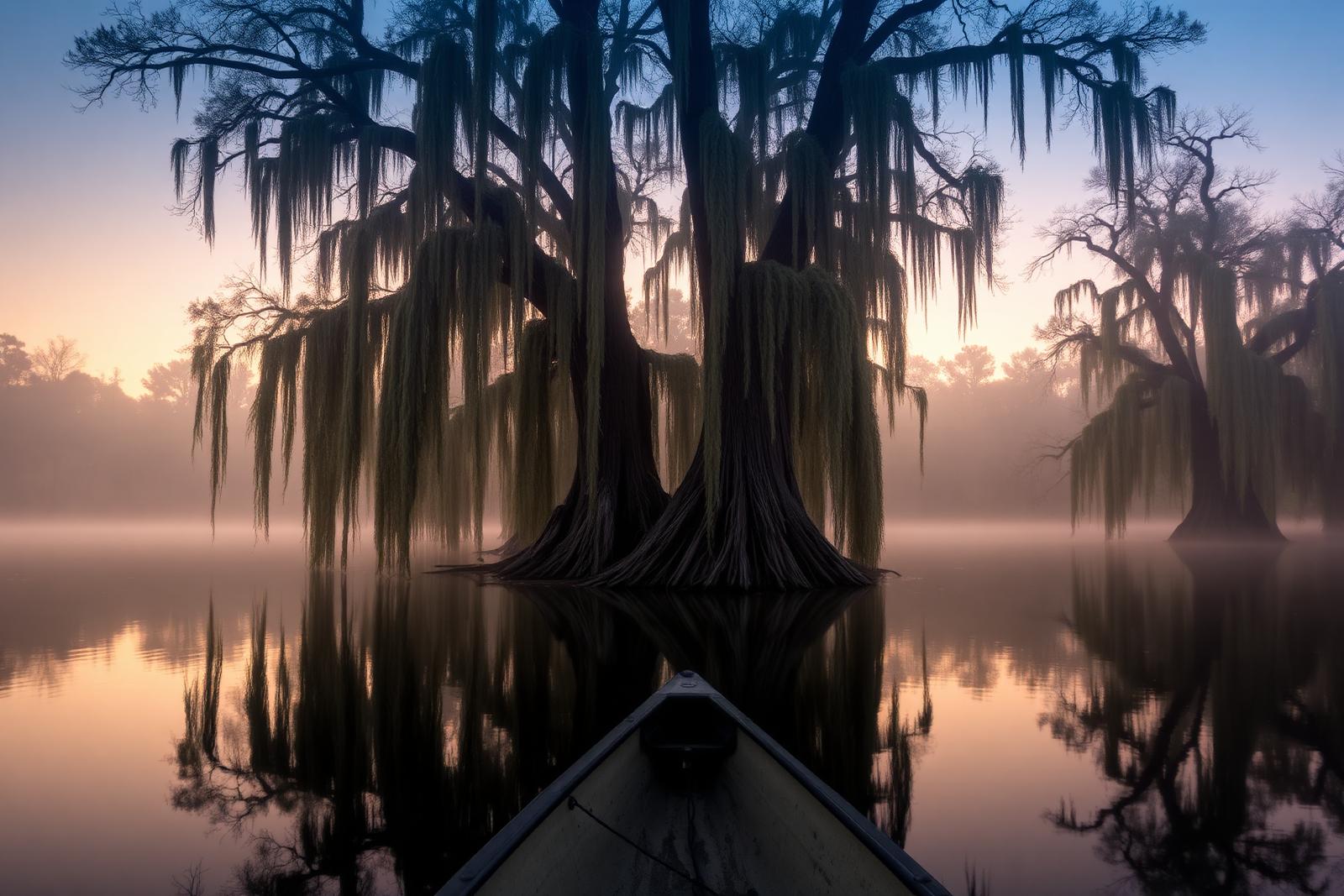
There is a town on Caddo Lake called Uncertain, and before sunrise the name feels less like a joke than a warning. The pavement narrows, porch lights disappear behind trees, and the road reaches water that does not look like the open-water lakes most Texans know. Cypress trunks rise straight out of the dark. Spanish moss hangs from their limbs. A few porch lamps reflect in black water, and beyond them the channels disappear into fog.
This is the hour to see Caddo. Not because the lake is empty — fishermen are already moving and birds have been awake longer than you have — but because dawn briefly makes the place legible. The water is often still enough to mirror every cypress knee. Mist sits low over the boat roads. Sounds travel farther than they should. Somewhere behind the trees, an outboard starts, runs for half a minute and vanishes again.
A lake that behaves like a forest
Caddo is easiest to understand once you stop expecting a conventional lake. It is a broad wetland and bayou system straddling the Texas-Louisiana line, a place of open pools, sloughs, backwaters and flooded forest connected by passages that can look almost identical from the seat of a kayak. The bald cypress are the defining feature, many standing in shallow water with flared bases and knobby knees around them. Their branches collect resurrection fern and Spanish moss until the canopy looks older than the map in your dry bag.
The water gets its tea-dark color from tannins released by leaves and other plant material. In the right light it can look opaque, then suddenly become a perfect mirror. Duckweed and water lilies gather in quiet pockets. Great blue herons stand at the edges. Egrets lift from branches ahead of the boat. In spring, prothonotary warblers add flashes of yellow to a landscape otherwise built from green, gray and brown.
Why the boat roads matter
The passages through Caddo are commonly called boat roads, and the name is useful because it reminds you that navigation here is not simply a matter of pointing across open water. Marked routes thread between trees and connect communities, fishing water and larger channels. Some bends are obvious. Others present two equally convincing choices, each framed by cypress and each appearing to continue exactly where you intended to go.
That is why a first trip is better with a local guide or on a short, well-understood route. A phone can be useful, but electronics are not a substitute for knowing where you launched, watching markers and understanding how quickly the scenery can repeat itself. Download maps before leaving reliable service, carry a waterproof backup, and do not assume that because you can still hear a motor somewhere nearby you know where the main channel is.
In a kayak, the reward for moving slowly is that the lake starts revealing distances you would miss in a powerboat. A narrow opening that looked like a dead end becomes another lane through the trees. A patch of floating vegetation turns out to be crossed by a dark seam of navigable water. The shoreline becomes less important because, in much of the flooded forest, there is no clean edge between land and lake at all.
The first two hours are the trip
For a casual visitor, the best plan is simple: launch early and resist the urge to cover mileage. Morning gives you cooler air, softer light and usually calmer water. It also gives wildlife a head start before the day gets busier. Paddle quietly enough and you begin noticing movement that would otherwise disappear into the background — turtles slipping from logs, a kingfisher crossing the channel, woodpeckers working the trunks and small birds moving through the moss overhead.
Spring is especially alive. Migratory birds move through the region, trees leaf out, and mornings can still feel cool enough for a light layer. Fall trades bright spring green for quieter weather and fewer insects. Summer is beautiful but demands more respect: heat and humidity build early, storms can develop quickly, and the still air among the trees can make midday feel much hotter than the thermometer suggests.
Fog is part of the appeal until it becomes a navigation problem. If visibility is poor, shorten the route and stay conservative. Caddo rewards people who accept that the conditions get to set the schedule. The photograph you came for may appear twenty minutes after sunrise, or not at all. The lake does not owe anyone a clear morning.
What to bring on the water
- A properly fitted life jacket worn while paddling, not stored behind the seat.
- A downloaded map plus a waterproof backup and the location of your launch marked before departure.
- Drinking water, sun protection and insect repellent even on cool mornings.
- A dry bag for keys, phone and anything that cannot survive a capsize.
- A small light if launching before sunrise or returning near dusk.
- Binoculars if birding is part of the plan, secured with a strap.
Leave the speaker at home. Caddo's best soundtrack is already there, and quiet also makes you a better paddler around anglers, birds and other visitors. Give powered boats room, stay visible in channels and avoid cutting across traffic where sight lines are limited by trees.
Uncertain is part of the experience
A Caddo trip makes more sense if you spend some time around Uncertain rather than treating the town as a parking lot for the lake. The community sits close to the water and has long been tied to fishing, guiding and visitors who come specifically for this landscape. It is small enough that directions often sound like landmarks instead of addresses, which somehow feels appropriate after a morning spent following numbered passages through cypress.
Nearby Caddo Lake State Park gives visitors another way into the ecosystem, with camping, paddling access and trails through the East Texas woods. The park and the communities around the lake also make an overnight stay worthwhile. Arriving the evening before means you can be on the water when the light is best instead of making the last hour of a long drive in the dark and then trying to learn a launch at dawn.
A place to look at twice
The first look at Caddo is all atmosphere: the moss, the dark water, the cypress silhouettes and the feeling that the channel ahead belongs in another century. The second look is better. Once the scenery stops overwhelming you, details take over. You notice which passages have current, where open water begins, how the vegetation changes near a channel and how quickly a familiar stand of trees can disappear when you turn around.
That is the real reason to paddle rather than rush through. Caddo is not a checklist lake. There is no single overlook that explains it, no summit where the geography suddenly makes sense. Understanding comes a few hundred quiet yards at a time, by following one boat road, then another, then turning back while you still know exactly how to get home.
By late morning the fog has usually burned away, the mirror has broken into ripples and the channels no longer feel quite as mysterious. You load the kayak, find the road out of Uncertain and realize the lake has performed a small trick: after two hours of concentrating on every turn, ordinary pavement feels almost impossibly straightforward. That contrast is part of why Caddo stays with people. Texas has bigger reservoirs and clearer swimming holes. It has rivers made for tubing and lakes built for speed. Caddo asks for something different — attention — and gives back a landscape that becomes stranger, and more beautiful, the longer you look at it.
Filed under
Plan Your Visit
Places connected to this story
Destinations explicitly tied to this article in the Texas Defined guide.
Uncertain
Caddo Lake
A maze of bald-cypress bayous, Spanish moss and dark water on the Texas–Louisiana line, best explored slowly by paddle beneath one of the state's most distinctive forest canopies.
Best season: Fall through spring for paddling and birding; spring brings lush growthUpdated Aug 2026- Bald-cypress swamp
- Marked paddling trails and boat roads
- Birding and wildlife
From the magazine
More stories to read next
Lakes & Rivers
Rio Grande Wild and Scenic River in Texas: Canyons, River Permits and Trip Planning
October 17, 2026 · About 4 minutes
