
County Guide
Collin County
Collin County grew from a scattering of prairie farms around McKinney into one of Texas's largest and fastest-growing counties, while historic town squares, creeks and Blackland Prairie landscapes still reveal the older North Texas beneath the boom.
- Guide type
- Texas county guide
- County seat
- McKinney, Texas
- Source check
- Official source checked
- Last reviewed
- August 4, 2026
Verified county profile
What the data says about Collin County
The 2020 Census counted 1,064,465 residents across about 841 square miles of land. Dividing those two Census figures gives roughly 1,265 residents per square mile.
Census geography also records about 45 square miles of water. Water represents approximately 5.0% of the county's mapped land-and-water area.
McKinney is the verified county seat.
Beyond the county seat, the current structured place directory links this county to Allen, Frisco, and Plano. This is a directory relationship, not a claim that the list contains every incorporated place or settlement in the county.
Understand the bigger picture
These Texas Explained guides add statewide context to the geography, settlement and infrastructure behind Collin County.
Explore Texas Explained →Historic places in this county
History you can visit in Collin County
Texas Defined currently connects 2 historic destinations to this county guide.
Statewide context
Where Collin County sits in the county data
These ranks use the same Texas State Library and U.S. Census county dataset as the statewide comparison. A rank is shown only when that metric is available for the county and the comparison set; missing source values are excluded rather than estimated.
- 2020 population
- #6
- of 254 counties with source data
- land area
- #187
- of 254 counties with source data
- population density
- #6
- of 254 counties with source data
- water share
- #28
- of 254 counties with source data
Property tax rates
Taxing units in Collin County
Texas property taxes are imposed by separate local taxing units. The table below lists finalized statewide records associated with Collin County. A district appearing here does not mean every property in the county pays that district; use the exact parcel record to determine jurisdiction.
Checking finalized local tax rates…
Lakes and recreation
Fishing lakes in Collin County
These source-backed TexasDefined guides cover reservoirs and public lakes associated with this county. Review access and the managing agency's current notices before travel; a county link does not imply every part of a lake or every ramp lies within the county.
At a glance
The county in numbers
- County seat
- McKinney, Texas
- 2020 population
- 1,064,465
- Land area
- 841 sq. mi.
- Water area
- 45 sq. mi.
- Population density
- 1,265 / sq. mi.
- Water share
- 5.0%
County questions
Quick answers about Collin County
What is the county seat of Collin County?
McKinney, Texas is the county seat of Collin County.
How many people live in Collin County?
The 2020 U.S. Census counted 1,064,465 residents in Collin County.
How densely populated is Collin County?
Using the 2020 Census population and Census land-area figure, Collin County has about 1,265 residents per square mile. This is a derived density figure, not a separate Census estimate.
What cities and communities are in Collin County?
Collin County includes communities such as McKinney, Allen, Frisco, Plano. City limits, mailing addresses and county boundaries do not always match, so verify an exact address when county jurisdiction matters.
Where do I look up property taxes in Collin County?
Start with the verified Collin County property-tax guide for the local workflow. The appraisal district handles property records, values, exemptions and protests; the designated collecting office handles bills and payments for each taxing unit.
How do I research industries and employers around Collin County?
Start with the sector guides most closely tied to Collin County's documented economy, then use Made in Texas and local sources to verify individual employers and facilities. These links describe county-to-sector context; they do not claim that every company in a statewide industry operates in Collin County.
How do I find official Collin County government information?
Start with the official Collin County website for county departments, services, courts and records. For property values, exemptions and protests use the appraisal district; for tax bills and payments use the office designated by the taxing unit. TexasDefined's verified county property-tax guide explains which local office handles each step.
Property taxes
County property-tax resources
Property-tax questions in Collin County involve several separate authorities. Use the verified county property-tax guide for the full workflow, then move to the appraisal district for values and exemptions and the correct collecting unit for billing and payment.
Property & county services
Official local resources
Property appraisal
Chief appraiser: Marty Wright
Phone: 469-742-9200
250 Eldorado Pkwy. McKinney, TX 75069-8023
Comptroller office listing updated 2026-07-15; confirm contact details with the district before visiting.
Tax office
Tax assessor-collector: Scott Grigg
Phone: 972-547-5020
2300 Bloomdale Road McKinney, Texas 75071-8517
Comptroller office listing updated 2025-03-13; confirm vehicle and tax service details with the office before visiting.
County feature
The story of Collin County
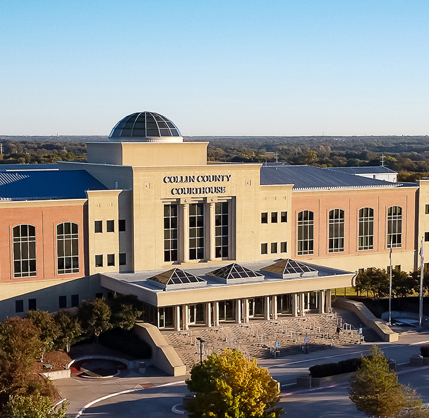
Collin County: McKinney, Blackland Prairie and a North Texas Boom
Collin County grew from a scattering of prairie farms around McKinney into one of Texas's largest and fastest-growing counties, while historic town squares, creeks and Blackland Prairie landscapes still reveal the older North Texas beneath the boom.
Published August 16, 2026 · Updated November 9, 2026 · 12 min read
Collin County is one of the clearest places in Texas to see how quickly a landscape can change without completely erasing what came before. Along the county's southern edge, Plano and Richardson merge into the continuous urban fabric of the Dallas-Fort Worth region. Farther north, Frisco, Allen, McKinney and Prosper have expanded across former farm and ranch land at a pace that has made the county a national shorthand for suburban growth. Yet the old courthouse square in McKinney, smaller communities such as Farmersville and Celina, creek bottoms, remnant prairie and agricultural roads still reveal an older North Texas beneath the new subdivisions and office campuses.
That contrast is the key to understanding Collin County. Its story did not begin with corporate relocations or toll roads. The county was created in 1846 from territory that had been part of Fannin County and was named for Collin McKinney, a pioneer, surveyor and statesman who helped draft and signed the Texas Declaration of Independence. What followed was nearly two centuries of settlement, farming, railroad building, small-town commerce, suburbanization and metropolitan growth layered onto the same Blackland Prairie landscape.
A county named for a founder of Texas
Collin McKinney was already an important figure in Texas history before the county took his name. Born in 1766, he moved through several states before settling in what was then Mexican Texas. At the Convention of 1836 at Washington-on-the-Brazos, he was the oldest delegate and one of five men selected to help draft the Texas Declaration of Independence. Collin County's official history notes that the county was established in 1846 and named for him, as was the county seat that followed two years later.
The names connect local geography to the founding generation of the Republic. They also point to the importance of surveying and county government in early Texas. McKinney worked as a land surveyor, and county boundaries, roads and seats of government were practical concerns in a state where distance could make access to a courthouse difficult. The county that bears his name would eventually become one of the most densely connected parts of Texas, but it began as scattered farms on a broad prairie.
Buckner came first, but McKinney became the seat
The first county seat was Buckner, a settlement northwest of present-day McKinney. The arrangement did not last. State law required the seat to sit close to the county's geographic center, and voters considered new locations. McKinney's official history records that heavy rains and swollen creeks complicated access to the polls for supporters of a competing site near Sloan's Grove. In 1848 the Legislature established McKinney as the county seat.
The move mattered because county seats were more than administrative addresses. Courts, land records, elections and commerce brought residents into town. Stores and homes clustered around the square, and the town became the county's civic anchor. Even after larger cities emerged elsewhere in Collin County, McKinney retained that governmental role and a historic center that gives the county a visible connection to its nineteenth-century origins.
The Blackland Prairie shaped the first economy
Collin County lies within the Blackland Prairie, a belt of dark, fertile soils that arcs through North and Central Texas. Early settlers turned the prairie into farms producing wheat, corn and later cotton. The county's official historical account describes a population of only about 150 around the time the county was created, with family-run farms forming the core of the economy.
Agriculture changed the appearance of the prairie but remained tied to its soils and rainfall. Creeks cut through the rolling terrain, and the lack of dense forest made much of the land attractive for cultivation. Today roads, rooftops and commercial districts dominate large areas that once held fields, yet the county's topography still reflects that prairie foundation. Open land near the northern and eastern edges offers glimpses of the setting that defined Collin County for generations.
Railroads connected the farm towns
Railroads transformed North Texas in the late nineteenth century, and Collin County's communities grew around the new connections. McKinney, Plano, Allen, Frisco, Farmersville, Wylie and other towns benefited from access to regional markets. Grain, cotton, livestock, passengers and manufactured goods could move farther and faster than wagon roads allowed.
The railroad era left a durable imprint on town form. Historic commercial blocks, depots, warehouses and street grids still help explain why certain communities became local centers. Even where tracks no longer dominate daily life, the pattern of compact downtowns surrounded by later development is visible. In McKinney, the historic square remains one of the county's most recognizable destinations and demonstrates how a nineteenth-century civic center can survive inside a twenty-first-century metropolitan county.
Historic McKinney anchors the county's older identity
Downtown McKinney is especially useful for understanding Collin County before the suburban boom. The courthouse square is surrounded by preserved commercial buildings and streets that retain the scale of an older county-seat town. The historic courthouse itself traces its site to a nineteenth-century building dedicated in 1876 and later substantially remodeled; the old civic structure now serves a cultural role rather than functioning as the modern county courthouse.
A short distance away, the old Collin County prison adds another layer. The county identifies the 1880 Victorian Italianate structure as one of Texas's oldest nineteenth-century county jails remaining substantially in original condition. Built of locally quarried fossiliferous limestone and designed by Austin architect F. E. Ruffini, it reflects the practical institutions that accompanied county government as settlements became established communities.
Plano signaled the suburban transformation
The second half of the twentieth century changed Collin County more dramatically than any earlier period. Plano, directly north of Dallas, became a major suburban city and employment center. Housing subdivisions spread across former agricultural land while corporate campuses, shopping centers, schools and highways followed. The county's relationship with Dallas shifted: it was no longer primarily an agricultural hinterland sending products south, but part of an integrated metropolitan economy.
Plano's rise established a pattern that later spread north. High-quality road access, large tracts of developable land, expanding school systems and proximity to major employment centers attracted residents and businesses. What looked like the northern edge of metropolitan Dallas in one decade often became the established middle of the region in the next.
Frisco, Allen and McKinney pushed the growth line north
Allen, Frisco and McKinney became major cities as the metropolitan growth front moved northward. Each developed a distinct civic identity, but all were shaped by the same powerful forces: regional highways, employment growth, master-planned housing, schools, retail and the appeal of new construction. Frisco in particular became known for large-scale sports and entertainment development, while Allen built its own concentration of retail and residential growth.
McKinney presents the sharpest contrast between old and new. A visitor can move from a historic courthouse square to extensive modern neighborhoods and commercial corridors in minutes. The city's expansion has not erased the county-seat core, but it has changed its context completely. What was once a small town serving farmers is now the governmental center of a county with well over a million residents.
The numbers show the scale of the boom
The U.S. Census Bureau counted 1,064,465 people in Collin County in the 2020 census, up from 782,341 in 2010. Its July 1, 2025 population estimate reached 1,297,179, an increase of 21.7 percent from the 2020 estimates base in only five years. Those numbers place the county among the largest population centers in Texas and make its growth more than a local development story.
Population growth changes almost every public system at once. Roads carry more traffic, school districts build campuses, cities extend utilities, parks and fire stations move outward, and county courts and administrative services handle more residents. The modern Collin County Courthouse and government complex in McKinney reflect that expanded scale. The county government serving today's population is operating in a fundamentally different environment from the courthouse-centered community of the nineteenth century.
A modern economy grew beside the subdivisions
Collin County's transformation has not been residential alone. Corporate offices, technology firms, financial services, health care, higher education, professional services, construction, retail and hospitality have created a large employment base inside the county. Plano's Legacy area and other business districts helped establish the county as a place where people work as well as commute from.
The result is a more complex metropolitan pattern than the old suburb-and-core model suggests. Residents may live in McKinney, work in Plano, attend an event in Frisco and shop in Allen without leaving Collin County. The county increasingly functions as a collection of interconnected cities with their own job centers rather than as a bedroom community attached to Dallas.
McKinney National Airport adds commercial flights in November 2026
One of the most visible changes to Collin County's transportation network is scheduled for November 11, 2026: McKinney National Airport's first commercial passenger departure. The airport has long handled general aviation; the new commercial terminal creates a new choice for people traveling to or from northern Collin County. For commercial flight searches, the McKinney airport uses the booking code DTX. Its former TKI identifier continues for general aviation operations. Travelers should confirm the airport code when comparing Dallas-area flights rather than assuming that a fare listed for DFW or DAL is departing from McKinney.
The first scheduled Avelo departure is to Southwest Florida International Airport at Fort Myers on Wednesday, November 11. Orlando and Las Vegas are scheduled to start November 12; Fort Lauderdale and Tampa follow November 19. The City of McKinney's September 24 announcement also lists Atlanta and Denver service beginning December 16 and Nashville and New Orleans starting December 17. Route announcements are not evidence that a flight has operated, and schedules, destinations, fares and frequencies can change. For a trip, use the airport's official FlyDTX site and the airline's current booking system rather than relying on launch-era route counts.
The new passenger terminal is at 1910 FM 546. City plans describe a 46,000-square-foot building opening with four passenger gates, with capacity to expand to six; they also describe onsite car rentals, ground transportation and about 980 public parking spaces. These are announced opening-period facilities, not a promise of same-day availability. DTX may shorten ground travel for some residents of McKinney, Allen, Anna, Melissa and neighboring communities, but it does not replace DFW International or Dallas Love Field for every destination or connection. Compare the entire itinerary, baggage policies, flight days, parking and ground travel. Scheduled flights are a new stage of county connectivity, following the railroads that linked prairie towns and the highways that linked expanding suburbs to Dallas.
Lavon Lake and the eastern county preserve open horizons
Growth is most intense along the central and western corridors, but eastern Collin County offers a different perspective. Lavon Lake, created on the East Fork of the Trinity River, is a major water-supply and recreation feature. Around it, communities such as Wylie, Princeton, Farmersville and Lavon connect the metropolitan county to landscapes that remain more open and, in places, visibly agricultural.
The lake also illustrates a recurring North Texas theme: water infrastructure makes urban growth possible while creating new recreational landscapes. Reservoirs, creeks and floodplains are not empty spaces between developments; they are part of the physical system that supports the region. Parks, boat ramps and shoreline areas provide some of the county's broadest public views of sky, water and prairie.
Small towns remain part of the county story
Celina, Prosper, Anna and Melissa have become prominent growth communities, while places such as Farmersville, Blue Ridge, Nevada and Josephine retain smaller-town patterns even as development approaches. Their futures will not necessarily mirror the older suburbs exactly. New highways, employment centers and master-planned communities are reshaping the northern and eastern county on a larger scale than earlier generations experienced.
These places matter because Collin County's identity has never belonged to one city. McKinney is the seat, Plano was an early suburban powerhouse, Frisco became a major sports and business center, and smaller communities carry their own histories. Seeing the county as a network rather than a single urban mass makes its transformation easier to understand.
Historic preservation has greater value as growth accelerates
Fast growth can make surviving historic places more important because they provide reference points in a landscape where so much is new. Downtown McKinney, old commercial blocks, cemeteries, rural roads, farmhouses and community landmarks show how people organized life before multilane highways and large subdivisions. Preserving them does not stop growth; it gives growth a context.
The same is true of natural remnants. Blackland Prairie is one of the most altered ecosystems in Texas because its rich soils were so useful for agriculture and later development. Small preserved landscapes, creek corridors and open spaces help explain what the county looked like before urbanization and why early settlers valued the land.
How to experience Collin County as a county
Start in downtown McKinney. Walk the historic square, look at the old courthouse and notice the compact blocks that organized county-seat life. From there, the old county prison and nearby historic neighborhoods add depth to the nineteenth-century story. Then drive south through Allen toward Plano to see how completely the county's landscape changed during the suburban era.
A second route should head west toward Frisco and then north through Prosper or Celina, where active construction makes the current growth frontier visible. For contrast, travel east toward Farmersville or Lavon Lake. The shift from dense development to water, prairie and smaller communities helps reveal the county's full geography rather than only its most famous suburban corridors.
Why Collin County matters to the Texas story
Collin County matters because its history connects two powerful Texas narratives: settlement of the North Texas prairie and the extraordinary metropolitan expansion of the modern state. It carries the name of a signer of the Texas Declaration of Independence, grew around farms and railroad towns, and still preserves a courthouse square that belongs to that older world. At the same time, it has become home to nearly 1.3 million people and one of the state's largest concentrations of new neighborhoods, corporate offices and rapidly growing cities.
The county's defining feature may be the speed with which these eras sit beside one another. A historic street in McKinney, a former cotton town, a technology office in Plano, a stadium complex in Frisco, a new subdivision near Celina and an open view across Lavon Lake all belong to the same county. Together they show how Texas growth works: not by replacing the past in a single moment, but by layering a new landscape over older routes, institutions and communities until both are visible at once.
Sources & verification
Research and official records
Research references support the editorial history and places described above. The official directories below help verify current county seats, census geography, property tax offices and vehicle services. Office personnel, contact details and links can change; check the agency website before traveling.
County-specific research references
Further county history research
Use the published county history as independent background reading, not as proof that every claim in this guide has been checked against that reference.
Museum and heritage guides
Museums connected to Collin County
Independent guides to collections, exhibits, visitor planning, accessibility and historical research. Verify each museum's current hours and admissions before traveling.
- Museum of the American Railroad
Frisco, Collin County · Exhibits and visitor planning
Freshwater swimming destinations
Documented swimming beaches in Collin County
These swimming beaches have direct managing-agency evidence. A swimming beach within a lake or state park is distinct from ordinary boat launches and shoreline access. Check current water conditions, park alerts and reservations before visiting.
- East Fork Campground Swimming Beach →
Lavon Lake · The official East Fork (TX) federal campground listing explicitly includes a swimming beach, 50 RV sites, 12 tent-only sites, showers, two boat ramps and a group shelter.
- Avalon Park Swimming Beach →
Lavon Lake · The federal Hackberry Pavilion listing locates its facility inside Avalon Park and identifies a sandy swimming beach used by day visitors.
Water parks & family aquatics
Water parks in Collin County
6 recorded indoor, outdoor or resort water-play facilities in this county. Most outdoor venues operate seasonally and resort access may be restricted. Confirm the official schedule, admission eligibility and rides directly before visiting.
- Frisco Water Park
Frisco · Outdoor · Municipal water park
Frisco Athletic Center policies and day passes
- Apex Centre Leisure Water Park
McKinney · Indoor & outdoor · Municipal water park
Recreation-center membership or daily access under center rules
- Carpenter Park Indoor Water Play
Plano · Indoor · Indoor public park
Recreation center daily admission or Plano recreation membership
- Oak Point Recreation Center Aquatics
Plano · Indoor & outdoor · Indoor public park
Recreation center daily admission or qualifying city recreation pass
- Tom Muehlenbeck Recreation Center Water Play
Plano · Indoor & outdoor · Indoor public park
Plano recreation center daily admission or qualifying membership
- Jack Carter Pool
Plano · Outdoor · Municipal water park
Plano city seasonal pool admission with resident and nonresident rates
Local places to visit
More to explore in Collin County
These additional local places complement the park, museum, beach and other destination guides on this county page. They are not ranked. For events, swimming, tours or restricted properties, always check current visitor information before traveling.
- History & heritage
Historic Downtown McKinney
Walkable historic square with late nineteenth-century architecture, shopping, art and local food; museum interiors have separate visiting rules.
- Art & architecture
McKinney Tiny Doors and Public Art Walk
Self-guided downtown exploration of miniature doors and public-art murals promoted in the official McKinney visitor directory.
RV parks & campgrounds
RV camping around Collin County
TexasDefined currently connects 3 RV park or campground directory entries to this county. Verify hookups, rig limits, rates and reservations with the operator before travel.
- Lake Lavon RV ParkNevada, Texas
- Clear Lake Park RV LoopWylie, Texas
- East Fork Park RV AreaWylie, Texas
Major annual events
Events worth planning around in Collin County
Texas Defined links only to event guides backed by organizer or equivalent first-party evidence. Future recurrence-derived dates are labeled on the event guide.
Texas tournaments
Tournaments & competitions near Collin County
Browse TexasDefined’s statewide tournament directory across golf, rodeo, team sports, fishing, BBQ, chess, esports, academic competitions and more. County relationships are published only when a location can be assigned confidently; current dates, venues and entry details require organizer verification.
Sports destinations
Major sports venues in Collin County
Verified TexasDefined sports venues assigned to this county. County-wide does not mean every venue is close to the county seat.
What major sports venues are in Collin County?
TexasDefined currently has 3 verified sports venue guides in Collin County, including Eagle Stadium, McKinney ISD Stadium & Community Event Center, and Children's Health Stadium at PISD. Open a venue guide for visitor planning and official event-day sources.
Texas high school football
High school football in Collin County
See current UIL football programs whose TEA school-directory records are in Collin County. Use the statewide finder to compare a specific high school or ISD before choosing where to live.
Open the statewide football finder →Loading current UIL football programs…
What this tells you: current 2026–28 UIL classification, football division, district and six-man/11-man format. School, ISD, city and county context is attached only when Texas Education Agency AskTED produces an unambiguous campus match; uncertain matches are deliberately omitted.
All-time state-final history: title and appearance totals use UIL’s Football All-Time Appearances table, supplemented with newer completed state-final rows from the official State Archives when that all-time table trails the latest archive. Totals appear only on an exact normalized UIL school-name match.
Recent state-final detail: the game-level list covers the eight completed UIL championship seasons from 2018–19 through 2025–26. No history badge does not mean a weak program; it means the source did not produce an exact normalized school-name match.
This is not a “best school” rating. Football placement and recent championship history are only parts of researching a program. Attendance zones, transfers, eligibility and campus assignments can change, so confirm an exact address and student eligibility with the school district and UIL before making a move.
Researched local football programs
Football history connected to Collin County
- Allen Eagles football authority guide →
Five UIL state titles, historic Kyler Murray era and 2026 Eagle Stadium visitor guidance
- Anna Coyotes football authority guide →
2023 Class 4A Division I state champion and current Coyotes program
- Blue Ridge Tigers football authority guide →
Blue Ridge ISD Collin County campus and 2026 UIL alignment
- Celina Bobcats football authority guide →
Nine UIL football state titles through 2024, March 2026 Marc Bindel appointment and new 5A Division II District 4
- Farmersville Fighting Farmers football authority guide →
Farmersville High School at 499 North State Hwy 78, Collin County; UIL 2026–28 4A Division II District 7; official Rank One varsity calendar and school-listed coach Zac Quinlan.
Independent editorial guides. Game sites and district boundaries may span county lines; each listed school is linked by its campus county.