60–90 minutes
Historic fort overview
- Start at the visitor center.
- Walk the fort ruins.
- Orient to the Clear Fork of the Brazos landscape.
Prairies & Lakes · Historic Sites & Museums
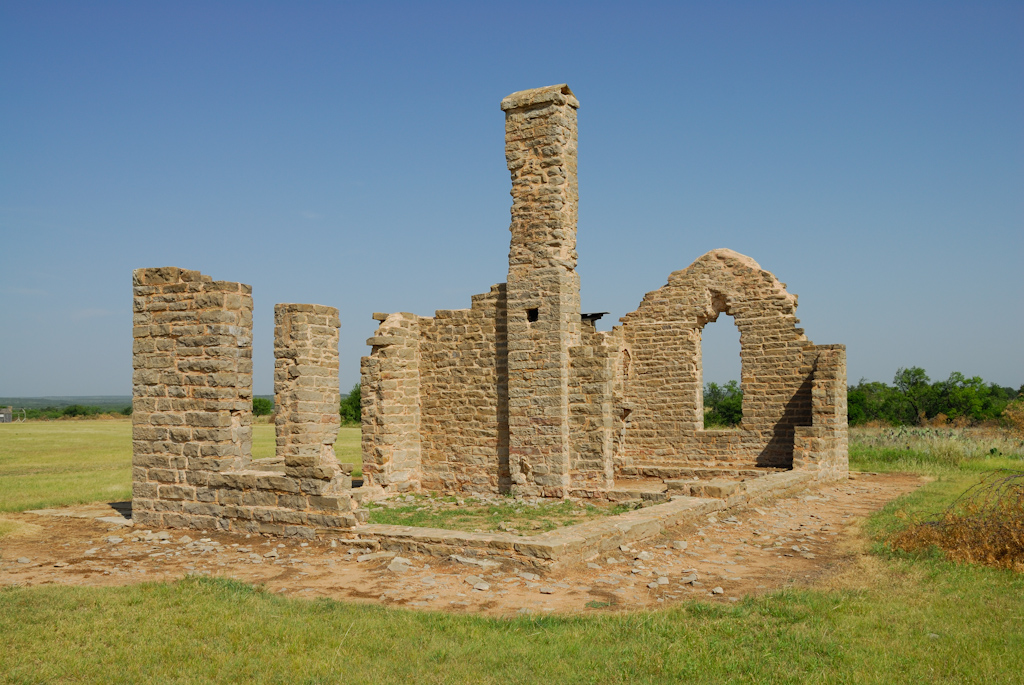
Fort Griffin operated from 1867 to 1881 as part of the U.S. Army's network of frontier posts on the Southern Plains. Ruins, military history and the surrounding ranch landscape make this one of the strongest places to connect frontier expansion with the cattle era.
Photography: Mark Fisher · CC BY-SA 3.0 · Wikimedia Commons · CC BY-SA 3.0 license ↗
Quick trip facts
The experience
Fort Griffin operated from 1867 to 1881 as part of the U.S. Army's network of frontier posts on the Southern Plains.
Ruins, military history and the surrounding ranch landscape make this one of the strongest places to connect frontier expansion with the cattle era.
Fort Griffin is more than a set of military ruins. The Texas Historical Commission also manages the Official State of Texas Longhorn Herd here, and its visitor guidance describes hiking, stargazing and overnight camping as parts of the site experience.
The fort was established in 1867 above the Clear Fork of the Brazos. Interpreting nearby cattle trails, buffalo hunting and the boomtown known as the Flat helps explain the economics and social disruption of the Texas frontier without reducing the story to an Army timeline.
Camp Wilson was founded in July 1867 above the Clear Fork of the Brazos and was renamed Fort Griffin. Despite plans for permanent construction, shortages of money and materials left the post with many temporary structures, making its surviving ruins a useful contrast to better-restored forts elsewhere in Texas.
The civilian settlement below the post, called the Flat or Hide Town, drew soldiers, merchants, drovers, buffalo hunters and people participating in a violent and fast-changing frontier economy. The boomtown should not be treated as a colorful anecdote; it explains how federal military spending, hides, cattle trails and new settlement interacted.
Fort Griffin supported campaigns associated with the Red River War of 1874–1875. Accounts of Army operations must also explain the lives of Native nations displaced and attacked, and why the destruction of the bison herds mattered materially to Southern Plains communities.
Today, the official longhorn herd, outdoor recreation and camping add substantial visitor value beyond the fort ruins. These experiences have their own timing and conditions, so check the Texas Historical Commission’s latest visitor guidance and do not assume cattle viewing, night-sky programs or guided interpretation occur at every visit.
Visitors can see surviving fort ruins, the visitor-center exhibits and the nearby Official State of Texas Longhorn Herd. The operator lists 33 overnight campsites, outdoor walking and stargazing, with some guided interpretation taking one to two hours. Herd viewing is subject to animal-management conditions and cannot be promised at every visit.
The details
Evidence and citations
Read the original operator records and supporting research for this guide.
Site history, longhorn herd and camping information.
Touring options, exhibits and on-site activities.
The visit
Texas context
Fort Griffin joins Army frontier history with the cattle-trail economy, buffalo-hunting boomtowns and the fate of the southern bison herds. It is also unusual among the forts on this list because visitors can connect preserved ruins with the Official State of Texas Longhorn Herd and outdoor recreation.
Use the time you have
60–90 minutes
2–3 hours
Half to full day
Key dates
A short chronology of dates that materially shaped this place. Each entry links to the source used for the date and historical context.
July 31, 1867
Lt. Col. Samuel Sturgis establishes the post, later renamed Fort Griffin, above the Clear Fork of the Brazos.
Source: THC — Fort Griffin history1874–1875
Fort Griffin supplies soldiers and operations in the campaign that transformed Southern Plains Native nations and Texas settlement.
Source: THC — Fort Griffin historyMay 1881
Military closure and shifting rail and cattle routes contribute to the decline of the boomtown known as the Flat.
Source: THC — Fort Griffin historyBefore you go
Around the area
Build a frontier-history day around Fort Griffin and Albany, connecting the Army post to cattle trails, buffalo hunting, ranching and the boomtown economy that grew around military expansion.
Easy additions that fit naturally around the main stop.
The Shackelford County seat is the practical base and adds ranching, courthouse and small-town history.
Dining districts and food areas worth building into the same outing.
Use this nearby community as the practical food and overnight base for the historic-site visit.
The most practical lodging areas for minimizing driving and maximizing time on the ground.
Use this nearby community as the practical food and overnight base for the historic-site visit.
Nearby parts of the city that add character, shopping, history or nightlife.
The Clear Fork landscape and open ranch country are essential to understanding why the post existed where it did.
Good nearby additions when the itinerary includes younger travelers.
Let the ruins and open ground carry the visit; the site's scale is easier to grasp on foot than from exhibits alone.
Places that justify extending the visit beyond the immediate area.
Compare two frontier posts that served different stretches of the North Texas military network.
Compare this landscape with other Army posts, frontier transportation routes, ranch country and the Native histories of westward expansion.
Connect longhorn preservation, cattle trails and Fort Griffin with Charles and Mary Ann Goodnight and the rise of large-scale Panhandle ranching.
Place this site inside the longer military chronology from the Texas Revolution and frontier Army through the Civil War, border mobilizations and the world wars.
Plan the route
Editorially paired stops near Fort Griffin State Historic Site appear first, followed by nearby destinations. Distances are approximate straight-line miles.
Albany · Shackelford County · Prairies & Lakes
The official state herd preserves and interprets the Texas Longhorn, the cattle breed inseparable from trail-driving and ranching history. Seeing the herd at Fort Griffin adds living context to the fort, ranching and cattle-trail stories preserved across North and West Texas.
Approx. 1 mile away
Albany · Shackelford County · Prairies & Lakes
The Old Jail Art Center in Albany transforms an 1878 stone jail into a nationally respected small-town art museum with modern and contemporary works, Asian art, Pre-Columbian material and the preserved architecture of the original jail.
Approx. 14 miles away
Breckenridge · Stephens County · Prairies & Lakes
Swenson Memorial Museum in downtown Breckenridge preserves Stephens County's pioneer, ranching, railroad and oil-boom history inside the 1920 former First National Bank building, with the adjacent J.D. Sandefer Oil Annex extending the story into the region's petroleum era.
Approx. 22 miles away
Breckenridge · Stephens County · Prairies & Lakes
Breckenridge is a Stephens County courthouse town with an oil-boom history, a mural-rich downtown, local museums and two major nearby lake landscapes—Hubbard Creek Reservoir and Possum Kingdom country—within an easy west-of-DFW road-trip corridor.
Approx. 22 miles away
Caddo · Palo Pinto County · Prairies & Lakes
Clear blue water and limestone cliffs on Possum Kingdom Lake, with boating, fishing, swimming, paddling, hiking, cabins, and camping.
Approx. 39 miles away
Graham · Young County · Prairies & Lakes
The Old Post in Graham is Young County's historic Old Post Office Museum & Art Center, pairing local history, rotating art exhibitions and educational programming inside the city's preserved 1936 federal post office.
Approx. 39 miles away
Texas Explained
Go beyond the destination with the systems, landscapes and history that explain why this part of Texas looks and works the way it does.
Continue exploring
Read next
Historic Sites
A practical Texas lighthouse guide comparing public access, climbs, viewing methods and trip logistics from Port Isabel to the Sabine gateway.
August 21, 2026 · About 12 minutes
Historic Sites
Missions, battlefields, courthouses and museums make more sense as a road map than a timeline. These are the places that turn state history back into geography.
August 7, 2026 · About 2 minutes