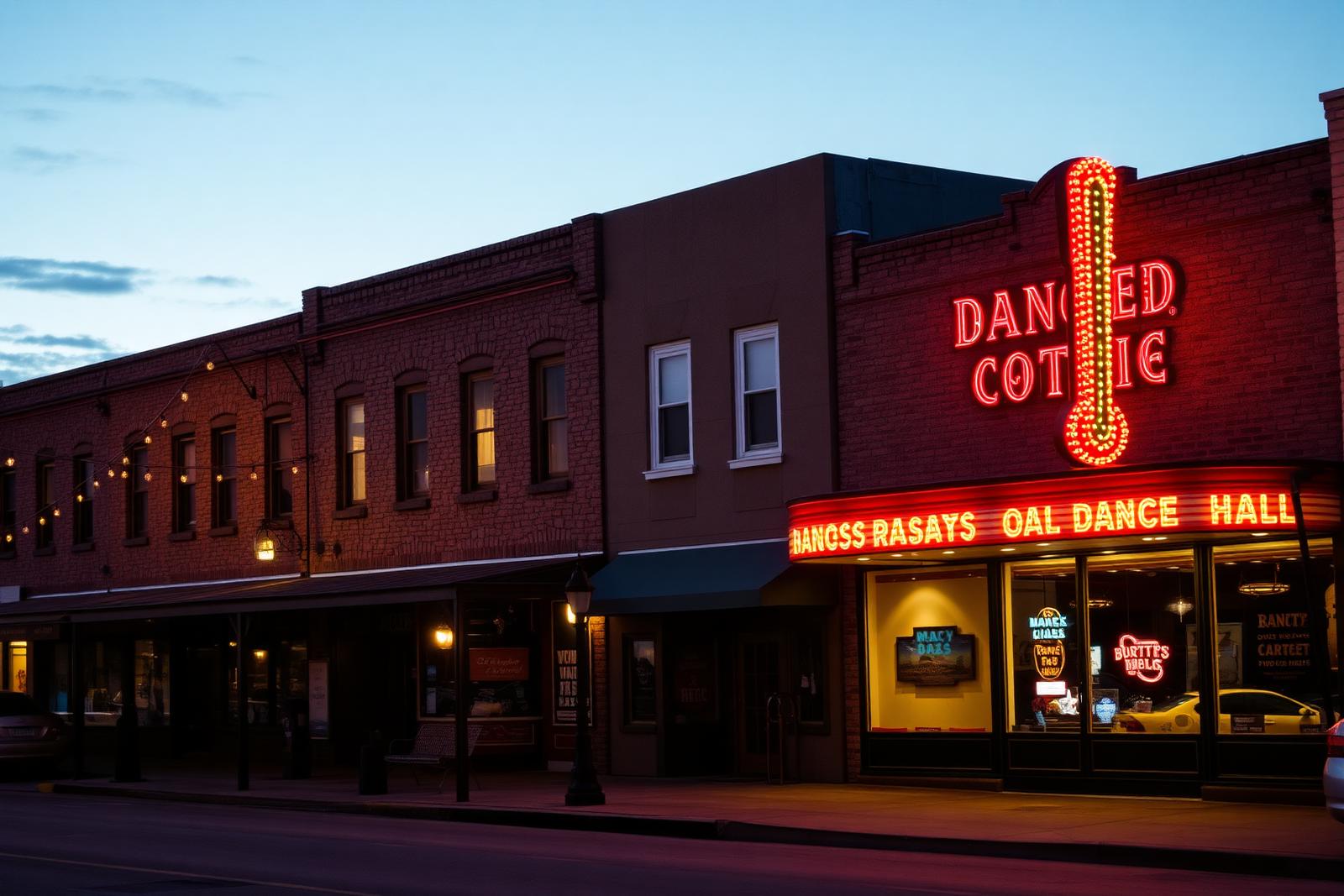
Recreated Gladys City commercial street
Walk the replica shops, businesses and period streetscapes that explain the lives of workers and families in the 1901 oil boom.

Gulf Coast · Historic Sites & Museums
Lamar University's Spindletop-Gladys City Boomtown Museum recreates the commercial streets and oil-field setting of the boom that followed the 1901 Lucas Gusher, using historic interpretation, furnished buildings and scheduled gusher reenactments.
Photography: i_am_jim · CC BY-SA 3.0 · Wikimedia Commons · File:The Spindletop-Gladys City Boomtown Museum.jpg · CC BY-SA 3.0 license ↗
Quick trip facts
The experience
Spindletop-Gladys City Boomtown Museum interprets one of the most consequential industrial events in Texas history through a physical landscape. The 1901 Lucas Gusher helped launch a petroleum boom that transformed Beaumont, attracted major investment and accelerated the growth of the modern oil industry.
Rather than presenting that story only through artifacts, the museum recreates parts of the commercial boomtown that grew around the oil field. Furnished buildings, derricks and demonstrations help visitors picture the sudden influx of workers, businesses and technology that followed the discovery.
The site pairs naturally with the Texas Energy Museum downtown. Gladys City provides the place-based boomtown experience, while the Energy Museum explains the science, technology and larger industry that grew from Spindletop. Together they make one of Beaumont's strongest industrial-history itineraries.
The details
Texas Defined research guide
Spindletop–Gladys City Boomtown Museum on the Lamar University campus reconstructs a turn-of-the-century oil boomtown to show what changed when the Lucas gusher erupted January 10, 1901. Visitors walk among reproduced storefronts, drilling structures and outdoor interpretation rather than only reading indoor exhibits; this is an especially useful companion to the Texas Energy Museum's geology and refinery exhibits.
Walk the replica shops, businesses and period streetscapes that explain the lives of workers and families in the 1901 oil boom.
Reconstructed drilling structures explain how oil was extracted and what made the Lucas gusher so disruptive to the regional and national economy.
The log-cabin saloon, stores and period trade exhibits show commerce and everyday life rather than merely celebrating industrial machinery.
Interpretive demonstrations and public events may bring the boomtown to life, but schedules depend on staffing; do not promise reenactors or a gusher demonstration on every visit.
Questions drawn from museum information, visitor discussions and independent visitor research. Answers are checked against linked sources; check the museum for today's operating details.
Lamar University lists standard admission as $5 adults, $3 seniors age 60+, $2 ages 6–12, with ages five or under free. Certain Lamar-affiliated visitors and eligible military personnel receive ID-based free admission. Check current event pricing and qualifications.
Checked · Source and current details
The official visiting page lists Tuesday–Saturday 10 a.m.–5 p.m. and Sunday 1–5 p.m., closed Mondays and major holidays. Last admission is 4 p.m.; arriving shortly before closing is not ideal for the open-air museum.
Checked · Source and current details
The historic boomtown streets and buildings are reconstructions that interpret life during the 1901 Spindletop oil boom. They are not the original intact town, so treat period settings as museum interpretation rather than untouched nineteenth-century buildings.
Checked · Source and current details
Lamar says much of the complex is wheelchair accessible, with benches on several porches. Outdoor surfaces and thresholds differ between reconstructed buildings; ask the museum for an actual route instead of assuming every display is step-free.
Checked · Source and current details
Leashed pets are allowed on the premises but not inside exhibition buildings, according to Lamar University's visitor page. Service animals are allowed inside according to the museum's service-animal rule; confirm any special accommodation directly.
Checked · Source and current details
Tours can be guided when docents are available, otherwise self-guided. Groups of 10 or more should book ahead; the operator does not give guided tours to groups over 30 people at once, although larger youth groups may be split. School-year and summer prices differ, and educators should confirm chaperone rules.
Checked · Source and current details
The museum interprets the 1901 Lucas gusher through replica derricks, reconstructed commercial buildings and occasional scheduled events. Do not assume a live gusher demonstration or reenactors are available on every ordinary visit.
Checked · Source and current details
The operator's current plan-your-visit page does not establish a regular full-service café or restaurant; there is a gift shop but that is not a dining facility. Plan an outdoor-appropriate outing and meals elsewhere in Beaumont.
Checked · Source and current details
An estimated 75–120 minutes is reasonable for a selective walk among recreated shops and derricks, accounting for heat, shade and individual mobility. It is an editorial estimate, not the museum's required tour length.
Checked · Source and current details
The Lucas gusher transformed Beaumont and the American oil economy in 1901; the outdoor reconstructed boomtown explains the workers, merchants, families, machines and speculative economy behind that turning point. The buildings are recreations rather than the original downtown settlement, an important distinction for visitors interpreting photography and regional history.
Connected museum guides
More researched museum guides linked by subject or region. Each museum has its own admission, hours and visitor policies.
Beaumont · Jefferson County
Beaumont · Jefferson County
Beaumont · Jefferson County
Port Arthur · Jefferson County
Beaumont · Jefferson County
Plan the route
Editorially paired stops near Spindletop-Gladys City Boomtown Museum appear first, followed by nearby destinations. Distances are approximate straight-line miles.
Beaumont · Jefferson County · Gulf Coast
The Texas Energy Museum in downtown Beaumont explains the 1901 Spindletop discovery and the science, technology and people behind the petroleum industry that transformed Southeast Texas and the global energy economy.
Approx. 4 miles away
Beaumont · Jefferson County · Gulf Coast
The Art Museum of Southeast Texas in downtown Beaumont presents changing exhibitions and a permanent collection emphasizing modern and contemporary American art, Texas art, regional artists and distinctive folk-art traditions.
Approx. 4 miles away
Beaumont · Jefferson County · Gulf Coast
The Fire Museum of Texas in downtown Beaumont traces firefighting from the nineteenth century to the present through historic apparatus, equipment, fire-safety interpretation and family exhibits in a former fire-station setting.
Approx. 4 miles away
Beaumont · Jefferson County · Gulf Coast
The McFaddin-Ward House Museum in Beaumont preserves a 1906 Beaux-Arts Colonial Revival home, original family furnishings, a carriage house and gardens that document the lives of a prominent Southeast Texas family during the region's oil-boom era.
Approx. 4 miles away
Beaumont · Jefferson County · Gulf Coast
Independent visitor guide to Beaumont's Babe Didrikson Zaharias Museum: Olympic and golf memorabilia, the champion's Texas legacy, admission and the conflicting Saturday-hours notices.
Approx. 5 miles away
Port Arthur · Jefferson County · Gulf Coast
J.D. Murphree WMA protects roughly 25,852 acres of fresh, intermediate and brackish coastal marsh near Port Arthur, forming a major upper-coast wetland complex beside Sabine Lake.
Approx. 12 miles away
Texas Explained
Go beyond the destination with the systems, landscapes and history that explain why this part of Texas looks and works the way it does.
Continue exploring
Read next
Historic Sites
A practical Texas lighthouse guide comparing public access, climbs, viewing methods and trip logistics from Port Isabel to the Sabine gateway.
August 21, 2026 · About 12 minutes
Historic Sites
Missions, battlefields, courthouses and museums make more sense as a road map than a timeline. These are the places that turn state history back into geography.
August 7, 2026 · About 2 minutes