1920 Baldwin Engine 13 and 1948 caboose
The preserved 68-ton locomotive, log car and caboose trace Texas Southeastern Railroad's connection to Southern Pine Lumber Company; visitors can experience stationary railroad equipment rather than a ride.
Piney Woods · Historic Sites & Museums
The History Center in Diboll offers free visits to historic exhibits, a stationary 1920 steam locomotive, a 1948 caboose, and the region's lumber, railroad and community history.
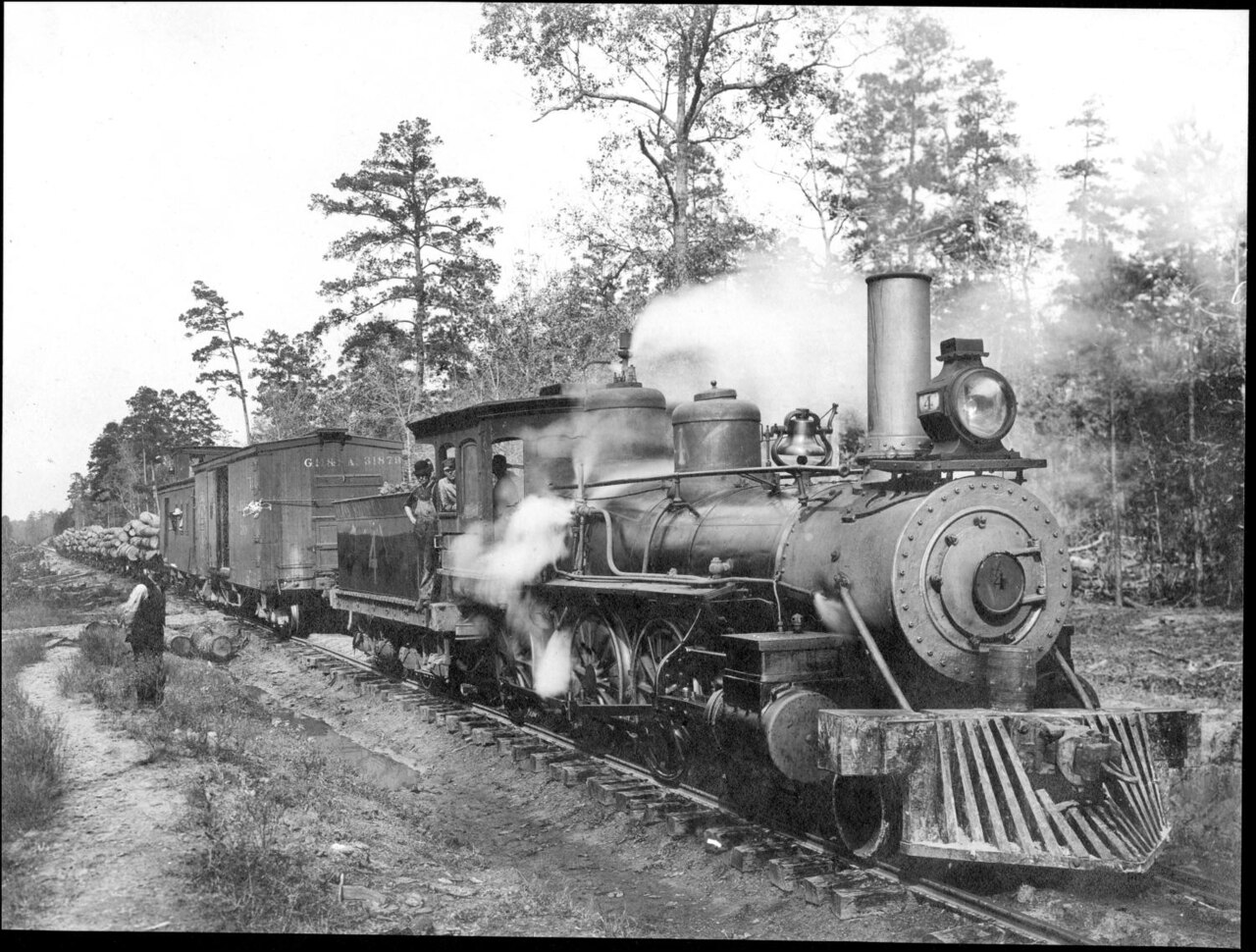
Photography: J. D. Cress · American Lumberman, 1907 · The History Center, Diboll / UNT Portal, collection 1994:004 · US public domain · Wikimedia Commons · File:Texas South-Eastern Railroad Engine 4.jpg · archival railroad photo, not museum exterior
Quick trip facts
The experience
The History Center in Diboll interprets East Texas railroad, sawmill and community history through public exhibits while separately preserving photographs, documents and oral histories for researchers. It is more than an archive, with indoor and outdoor displays designed for visitors.
The stationary 1920 Baldwin Engine 13 and 1948 caboose are tangible highlights, and the operator describes its outdoor railroad exhibit as fully accessible. Visitors may climb aboard and sound the whistle or bell under posted visitor arrangements, but there is no working train ride.
Inside, the eleven-panel Diboll: An Enduring Community exhibit traces the town's development as a sawmill company town. A free guided tour helps families or groups connect rail transportation, the local lumber industry and the lives of East Texans. Extensive archival content remains the institution's own specialist resource.
The details
Texas Defined research guide
The History Center in Diboll is an unusual hybrid of public historical exhibits and regional research archives. A restored 1920 Baldwin steam locomotive and 1948 caboose introduce families to East Texas logging and railroad history, while the indoor Diboll: An Enduring Community panels explain the sawmill-company town, local people and the economic changes that reshaped Angelina County. This is a destination to understand people and place, not a commercial train ride.
The preserved 68-ton locomotive, log car and caboose trace Texas Southeastern Railroad's connection to Southern Pine Lumber Company; visitors can experience stationary railroad equipment rather than a ride.
Eleven panels and more than 100 photographs trace the town from a sawmill settlement to a modern East Texas community, including workers and transportation.
The visitor center changes topical displays in the lobby and exhibition space; current titles should be checked with staff because past online exhibitions are not necessarily still on site.
Photographs and interpretive materials about railroad labor, education and community life are available digitally as a complement to the exhibits and as independent research.
Questions drawn from museum information, visitor discussions and independent visitor research. Answers are checked against linked sources; check the museum for today's operating details.
Yes. The operator explicitly states admission to the history center and its public exhibits is free. The visitor page also describes free guided tours, but these require advance arrangements; bring the current schedule rather than relying on an old directory listing.
Checked · Source and current details
The current operator lists Monday through Friday 8 a.m. to 5 p.m. as ordinary public hours. Saturdays are available by appointment with at least two weeks' advance notice, not as an ordinary drop-in period; the center is closed for most major holidays.
Checked · Source and current details
Yes, the operator describes its 1920 Baldwin Engine 13 and 1948 caboose as accessible stationary railroad exhibits and invites supervised visitors to climb aboard, ring the bell or blow the whistle when the display is available. It is not a working excursion train.
Checked · Source and current details
No scheduled moving-train excursion is advertised. The locomotive and caboose are restored stationary exhibits used to explain the timber and railroad economy; visitors can explore the preserved equipment rather than buy a railroad passenger ticket.
Checked · Source and current details
Its Diboll: An Enduring Community exhibition has 11 panels and more than 100 photographs, interpreting the town's growth and its lumber, railroad and social history. Rotating exhibits may feature other regional history topics, and the extensive archives remain a separate research resource.
Checked · Source and current details
The center says free staff-led guided tours usually take 50 to 60 minutes and should be arranged at least two weeks beforehand. Visitors can ask for an age-appropriate school group tour or a specialized research orientation; call the center to confirm availability.
Checked · Source and current details
The operator describes its outdoor railroad exhibit as fully accessible and invites visitors to interact with the preserved locomotive and caboose. For a particular wheelchair, walker, stroller or sensory accommodation, verify the exact route with the center ahead of arrival.
Checked · Source and current details
The operator's current visitor guide discusses exhibits, research, gift items and the free tour experience but does not document an on-site cafeteria or full-service restaurant. Plan meals in Diboll or nearby Lufkin instead of assuming food service inside the archives.
Checked · Source and current details
The permanent exhibit covers Diboll's emergence as a lumber-company town and the railroad, workers and community institutions that sustained it. The History Center also preserves photographs, oral histories, regional records and online interpretive exhibitions, including historic Black school communities and sawmill life. Explain that the collections are the museum's specialist research resources: TexasDefined links to them without duplicating the entire archive.
Connected museum guides
More researched museum guides linked by subject or region. Each museum has its own admission, hours and visitor policies.
Lufkin · Angelina County
Wharton · Wharton County
Alvin · Brazoria County
Amarillo · Potter County
Amarillo · Potter County
Plan the route
Editorially paired stops near The History Center (Diboll) appear first, followed by nearby destinations. Distances are approximate straight-line miles.
Lufkin · Angelina County · Piney Woods
Lufkin's Museum of East Texas is a free community art museum in a historic former Episcopal church, presenting rotating exhibitions, East Texas artists, broader American and international work, family programs and one of the region's strongest arts-education calendars.
Approx. 12 miles away
Lufkin · Angelina County · Piney Woods
Texas Forestry Museum in Lufkin interprets the forests and forest industries of Texas through sawmill, paper-mill, logging-railroad, conservation and family-learning exhibits, with free admission and an outdoor interpretive trail.
Approx. 12 miles away
Nacogdoches · Nacogdoches County · Piney Woods
A 2,560-acre USDA research forest southwest of Nacogdoches with a paved 0.8-mile Jack Creek Loop and a 1.5-mile natural-surface Management Loop on the operator's detailed map; the agency's descriptive webpage instead calls the latter 2.0 miles.
Approx. 22 miles away
Groveton · Trinity County · Piney Woods
Trinity County Museum in Groveton combines local-history exhibits with the Hensley Genealogical and Historical Research Center, preserving artifacts, photographs, family histories, obituaries and archival material from this East Texas county.
Approx. 22 miles away
Nacogdoches · Nacogdoches County · Piney Woods
Alazan Bayou WMA protects 2,063 acres of bottomland hardwood forest, old fields and floodplain habitat along the Angelina River and associated East Texas bayous south of Nacogdoches.
Approx. 24 miles away
Apple Springs · Trinity County · Piney Woods
Alabama Creek WMA covers 14,561 acres in Trinity County within Davy Crockett National Forest, combining East Texas forest habitat with public hunting, wildlife viewing and primitive outdoor recreation.
Approx. 26 miles away
Texas Explained
Go beyond the destination with the systems, landscapes and history that explain why this part of Texas looks and works the way it does.
Continue exploring
Read next
Historic Sites
A practical Texas lighthouse guide comparing public access, climbs, viewing methods and trip logistics from Port Isabel to the Sabine gateway.
August 21, 2026 · About 12 minutes
Historic Sites
Missions, battlefields, courthouses and museums make more sense as a road map than a timeline. These are the places that turn state history back into geography.
August 7, 2026 · About 2 minutes