Texas Explained
Texas Courthouse Architecture: Why County Seats Look So Different
Texas courthouses share a civic purpose but not a single look. Their towers, domes, stone, brick and symmetry reflect different eras, budgets, architects and ideas about what public buildings should say about a county.
Texas has 254 counties, and the courthouse was one of the most important public buildings many of them ever constructed. That produced a statewide collection with a shared purpose but remarkable architectural variety.
The Texas Historical Commission describes courthouses as some of the most widely recognized civic assets in Texas communities. Many were among the first substantial permanent structures in their counties, which helps explain why they still dominate so many town centers.
Why build something so monumental?
A courthouse handled practical work: courts, records, public meetings and county administration. But the building also represented permanence. A growing county wanted a courthouse that looked as though local government had arrived to stay.
That symbolic role encouraged counties to build more ambitiously than they might have for an ordinary office building. Towers, domes, clock faces, broad staircases and formal entrances made the courthouse visible from blocks away and announced the civic center of town.
There is no single Texas courthouse style
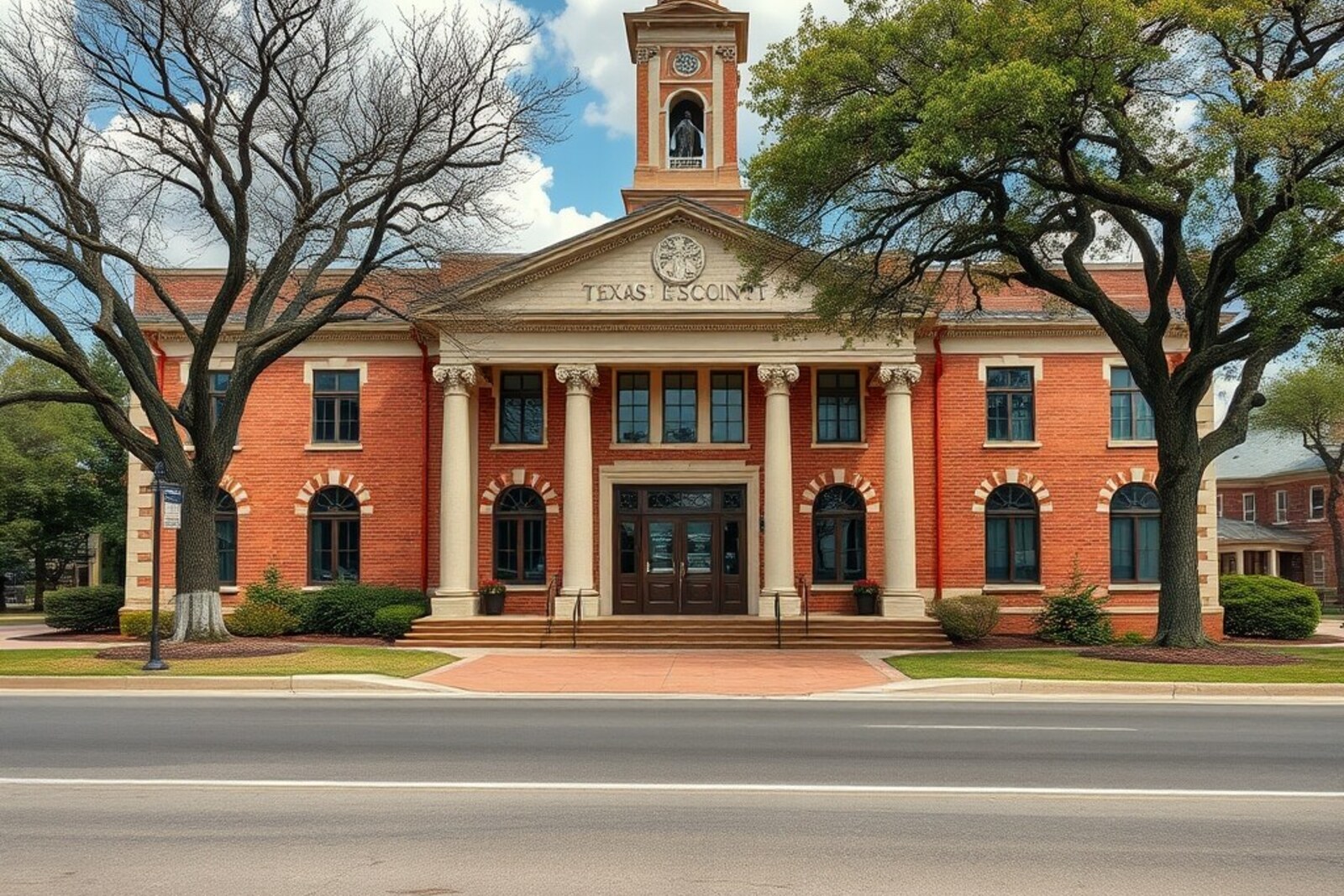
Historic Texas courthouses were built across different decades and architectural fashions. Some emphasize strong symmetry and classical details. Others use Romanesque arches, towers and heavy masonry. Later buildings may be more restrained, geometric or modern.
That variety matters because a courthouse is often a time capsule. Its appearance can reveal when a county experienced enough growth, confidence and tax base to replace an earlier structure with something more permanent.
Materials make the regional differences visible
Stone and brick appear again and again, but local availability and regional building traditions shaped how those materials were used. In limestone country, pale masonry can visually connect civic buildings with the surrounding geology. Elsewhere, red or buff brick became the dominant public face.
The courthouse therefore belongs to two maps at once: the political map of counties and the physical map of Texas materials, climates and construction traditions.
The square amplified the architecture
Many historic courthouses sit in or beside a courthouse square. The open space around the building gives it visual importance from several directions. Businesses facing the square reinforce the courthouse as the organizing object in the middle of town.
This arrangement is why courthouse architecture cannot be separated from town planning. The building was not just designed to be entered. It was designed to be seen while approaching the center of the county seat.
Why some courthouses disappeared
Not every historic courthouse survived. Fire, demolition, changing space needs and decades of deferred maintenance removed or threatened many buildings. The loss of courthouses from the mid-twentieth century onward helped create momentum for statewide preservation efforts.
The Texas Historic Courthouse Preservation Program was established by the Legislature in 1999. The program now combines grants, review, compliance and stewardship work aimed at preserving historic county courthouses and keeping them useful as modern public buildings.
Restoration is not the same as freezing a building in time
A working courthouse still has to serve a twenty-first-century county. Preservation therefore has to balance historic character with accessibility, building systems, safety, court operations and the practical needs of public employees and visitors.
The strongest restorations make the old building legible again while accommodating how modern government operates today.
What to look for when you visit a Texas courthouse
- The building's position on or near the town square.
- Whether the main entrance is emphasized with stairs, arches, columns or a tower.
- Local stone or brick that connects the building to regional materials.
- Domes, clock towers or rooflines designed to be visible from surrounding streets.
- Additions or restored sections that reveal how the courthouse changed as the county grew.
- The relationship between the courthouse and the commercial buildings around the square.
Courthouses are a statewide architecture collection hiding in plain sight
Texas county courthouses are useful precisely because they are not identical. Each county had the same basic civic need, but the solution changed with era, architect, budget, available materials and local ambition.
Drive from one county seat to another and the courthouse becomes a way to read Texas history without opening a textbook. The government function stays familiar. The architecture tells you how differently communities chose to express it.
Image credit: AI-generated editorial illustration · Texas Defined (Cloudflare Workers AI / FLUX.1 schnell)
Primary source: Texas Historical Commission ↗
From the magazine
More stories to read next
Then & Now
El Camino Real de los Tejas in Texas: Historic Trail, Sites and Visiting Guide
October 17, 2026 · About 4 minutes
Then & Now
Butterfield Overland National Historic Trail in Texas: Where to Visit and What Survives
October 17, 2026 · About 3 minutes