Southern Pacific depot architecture (1928)
Inspect the Spanish Colonial Revival railroad building as a preserved historic place and relate its design to the twentieth-century passenger-rail era.

South Texas Plains · Historic Sites & Museums
The Historic Brownsville Museum occupies the restored 1928 Southern Pacific Railroad Depot and interprets the founding and development of Brownsville through local-history exhibits, a rare 1872 Rio Grande Railroad locomotive and an adjoining education center.
Photography: 25or6to4 · CC BY-SA 3.0 · Wikimedia Commons · Southern Pacific Railroad Passenger Depot Brownsville Texas.jpg · CC BY-SA 3.0 license ↗
Quick trip facts
The experience
The Historic Brownsville Museum gives the city's origin story a transportation setting that is itself historically important. The Spanish Colonial Revival depot is a Recorded Texas Historic Landmark and National Register property, preserving the architecture of the passenger-rail era while the galleries explain Brownsville's establishment and later growth.
Railroad history is one of the destination's strongest differentiators. Admission extends to the Simón Celaya Railroad Gallery, where an 1872 Baldwin narrow-gauge locomotive helps explain the Rio Grande Railroad connection between Brownsville and Point Isabel. The adjoining education center supports rotating cultural programs and exhibits.
This destination forms one leg of the Brownsville Historical Association museum cluster. It pairs naturally with the Stillman House and Brownsville Heritage Museum while remaining a distinct stop because its depot, locomotive and transportation interpretation are different.
A visit here is partly architectural: the restored Southern Pacific depot interprets Brownsville's rail-era growth, while the Simón Celaya Railroad Gallery adds a historic narrow-gauge locomotive associated with Rio Grande transport. Distinguish the railroad's nineteenth-century story from the later depot building. Pair with Palo Alto Battlefield and the Brownsville historical district for context.
The details
Texas Defined research guide
This restored 1928 Southern Pacific depot makes Brownsville's railroad history tangible and explains the city's growth. Its included Simón Celaya Railroad Gallery is a strong reason to visit: the 1872 Rio Grande Railroad locomotive represents the earlier Brownsville–Point Isabel line and should not be mistaken for a 1928-era train.
Inspect the Spanish Colonial Revival railroad building as a preserved historic place and relate its design to the twentieth-century passenger-rail era.
An 1872 Rio Grande Railroad locomotive anchors interactive interpretation of earlier narrow-gauge travel, engine mechanics and the corridor toward Port Isabel.
Permanent interpretation addresses Brownsville's origins; rotating local-history exhibitions add topics that should be confirmed ahead of time.
A related venue for educational and cultural programming, with event-specific schedules that differ from gallery availability.
Questions drawn from museum information, visitor discussions and independent visitor research. Answers are checked against linked sources; check the museum for today's operating details.
Yes. The Brownsville Historical Association states that ordinary museum admission includes the Simón Celaya Railroad Gallery and the Mary A. Yturria Education Center where exhibitions or programming are available. Verify special access arrangements before departure.
Checked · Source and current details
The operator's current page lists Tuesday through Saturday, 10 a.m. to 4 p.m., with closure Sunday and Monday. Listed admission is $6 adults, $4 seniors, $2 students and free for children under six, military personnel, eligible Brownsville school groups and members. Recheck the operator for changes.
Checked · Source and current details
The Simon Celaya Railroad Gallery now includes interactive activities and the 1872 locomotive, with displays introducing how steam engines work. Other local-history and art exhibits are more interpretive, so choose a shorter family visit if needed.
Checked · Source and current details
No. The museum occupies a Southern Pacific depot constructed in 1928, while the displayed Rio Grande Railroad locomotive dates to 1872. Comparing the two illustrates different eras of Brownsville transportation.
Checked · Source and current details
Yes, the Brownsville Historical Association advertises prearranged museum tours, usually around an hour, with separate pricing and education/group scheduling. Do not assume a guided tour comes with walk-in admission.
Checked · Source and current details
The museum's current published overview does not establish restaurant service or step-free routes through every historic building. Contact the operator about visitor facilities, accessible entrances and any arrangements required for mobility or sensory needs.
Checked · Source and current details
Compare the 1872 Rio Grande Railroad between Brownsville and Point Isabel with the later Southern Pacific depot. This distinction reveals successive transport networks and the links among Brownsville's border trade, coastal ports and inland growth.
Connected museum guides
More researched museum guides linked by subject or region. Each museum has its own admission, hours and visitor policies.
Port Isabel · Cameron County
Alvin · Brazoria County
Frisco · Collin County
San Antonio · Bexar County
El Paso · El Paso County
Around the area
Make this visit part of a specific coastal Texas itinerary rather than a disconnected stop.
Easy additions that fit naturally around the main stop.
Earlier borderland military history
Dining districts and food areas worth building into the same outing.
Choose current independently verified dining options; availability changes by season.
The most practical lodging areas for minimizing driving and maximizing time on the ground.
Stay near the day's main stops; check travel and ferry logistics when relevant.
Nearby parts of the city that add character, shopping, history or nightlife.
Use the destination town as the geographic base for this visit.
Good nearby additions when the itinerary includes younger travelers.
Earlier borderland military history
Places that justify extending the visit beyond the immediate area.
Earlier borderland military history
The Civil War's final land battle
Plan the route
Editorially paired stops near Historic Brownsville Museum appear first, followed by nearby destinations. Distances are approximate straight-line miles.
Brownsville · Cameron County · South Texas Plains
The Stillman House Museum preserves one of Brownsville's oldest surviving homes, a Greek Revival residence associated with city founder Charles Stillman and the Treviño family, with original architectural features, courtyards and interpretation of nineteenth-century borderland life.
Approx. 1 mile away
Brownsville · Cameron County · South Texas Plains
The Brownsville Heritage Museum uses photographs, maps, costumes, artifacts and interactive displays to trace Brownsville and the surrounding region from exploration and settlement through ranching, transportation, education and the first half of the twentieth century.
Approx. 1 mile away
Brownsville · Cameron County · South Texas Plains
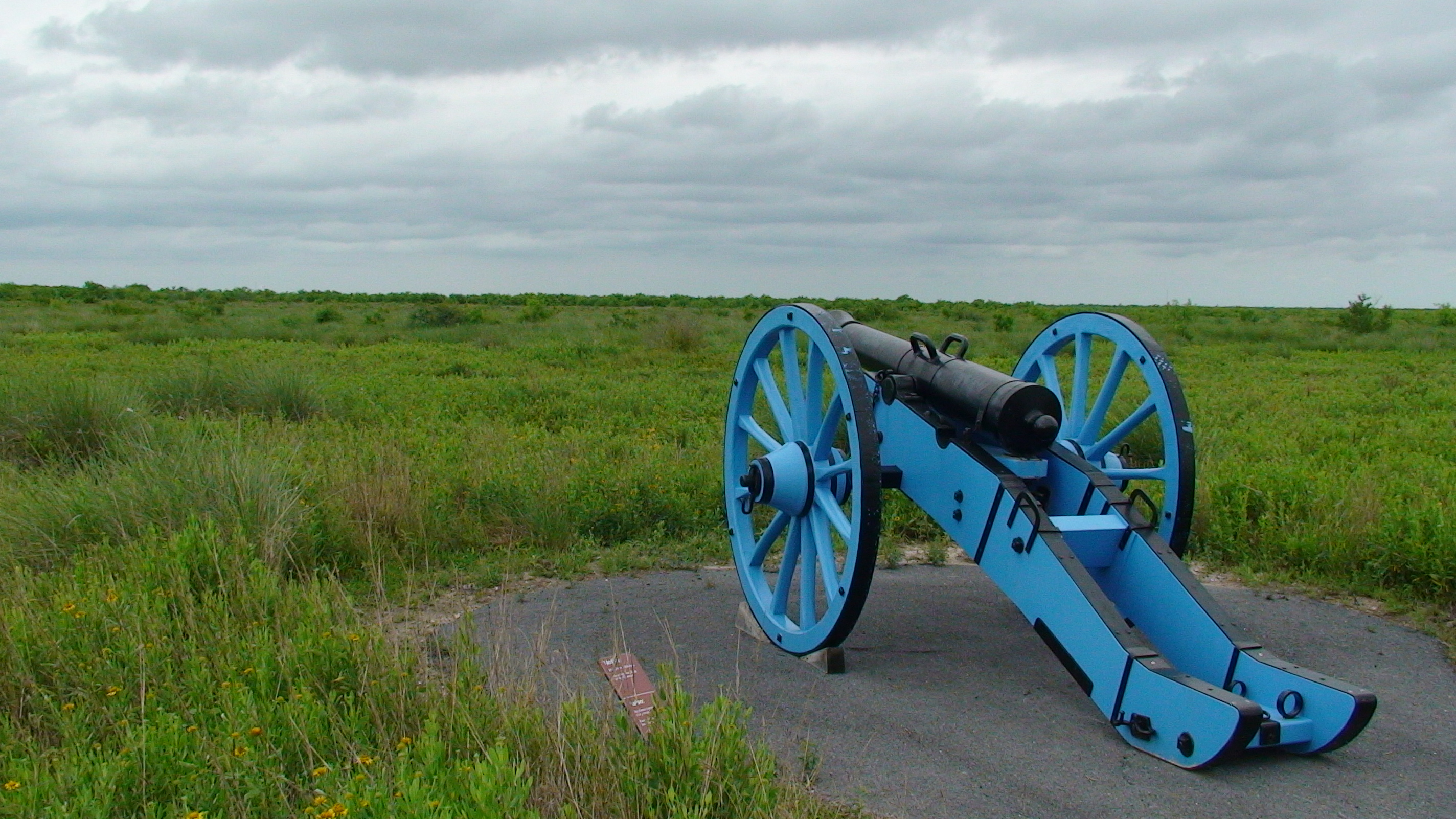
The preserved South Texas prairie where U.S. and Mexican armies fought the first major battle of the U.S.–Mexican War on May 8, 1846.
Approx. 8 miles away
Brownsville · Cameron County · South Texas Plains
A World Birding Center site protecting resaca wetlands and subtropical woodland, with exceptional birding, wildlife viewing, walking, biking, and tram access.
Approx. 8 miles away
Brownsville · Cameron County · South Texas Plains
Palmito Ranch is associated with the final land battle of the American Civil War, fought near the Rio Grande in May 1865. The remote battlefield is best approached as a landscape-history stop that explains why fighting continued in Texas after major Confederate armies had surrendered elsewhere.
Approx. 14 miles away
San Benito · Cameron County · South Texas Plains
San Benito's Freddy Fender Museum celebrates hometown singer Baldemar Huerta—internationally known as Freddy Fender—through personal artifacts, instruments, awards, photographs and exhibits tracing his path across country, rock, Tejano and border music.
Approx. 17 miles away
Texas Explained
Go beyond the destination with the systems, landscapes and history that explain why this part of Texas looks and works the way it does.
Continue exploring
Read next
Historic Sites
A practical Texas lighthouse guide comparing public access, climbs, viewing methods and trip logistics from Port Isabel to the Sabine gateway.
August 21, 2026 · About 12 minutes
Historic Sites
Missions, battlefields, courthouses and museums make more sense as a road map than a timeline. These are the places that turn state history back into geography.
August 7, 2026 · About 2 minutes