
Fish near bottom
Start: A bottom rig that avoids dragging through snags
Adjust: Adjust weight and leader for current
Watch for: Verify hook and bait-species restrictions
Bait technique
Live bait depends on keeping the bait alive and swimming naturally at the correct depth. A lively minnow hovering above a crappie brush pile calls for a different hook, leader and presentation than shad suspended over open water for stripers. Bait origin and transport rules matter before either rig goes into a lake.

Lake guides
65
Lake-linked species
11
Species documented in this method’s linked lake records
Seasonal scope
All year
This method has a year-round lake record, not a daily catch forecast
When to use
When you can identify a forage school or individual fish on sonar and hold a living bait just above the depth they occupy.
For crappie tucked into standing timber, bridge shade or brush, where a small minnow under a float can be presented repeatedly at one measured depth.
For open-water striped or hybrid bass where legally sourced, healthy shad can be kept in the fish's depth band without dragging a sinker through the school.
When fish inspect but ignore fast artificial presentations and a slower, self-moving offering gives them time to approach.
When a short, controlled drift or stationary presentation makes more sense than searching the entire shoreline with moving lures.
Texas rules
For live bait, the water in the bucket and the origin of the bait can change what is legal. These rules come from TPWD's current Outdoor Annual; verify the individual water and county before travel.
Choose the setup
Keep legal bait healthy, then choose a rig that controls depth without overpowering natural movement.
Rigging at a glance
The rig should control depth while allowing the bait to move naturally and remain healthy.
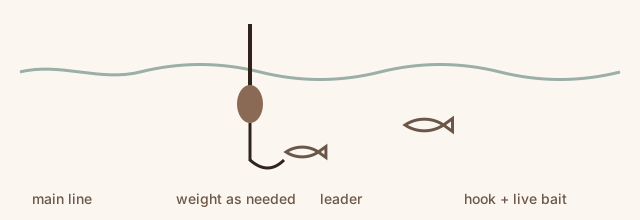
Place the bait at the fish's depth rather than simply on bottom.
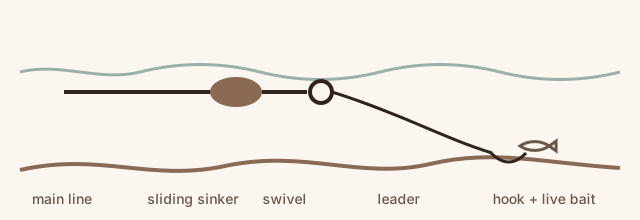
Use enough weight to hold position without unnecessarily restricting the bait.
On the water
A familiar bait may have different legal handling rules between Texas waters. Start with the situation that matches your water, then make one adjustment at a time.
Start: A bottom rig that avoids dragging through snags
Adjust: Adjust weight and leader for current
Watch for: Verify hook and bait-species restrictions
Start: A float or suspended rig set at observed depth
Adjust: Change depth instead of incessant casting
Watch for: Protect bait health
Start: Check the origin and legal transport status of bait
Adjust: Use compliant purchased bait or artificial lures
Watch for: Collected live bait cannot simply be moved between reservoirs
Where to fish
How to fish
Target differences
Hook size, bait size and depth control should change with the target fish and local forage.
This section describes how anglers may apply the method to different fish. The source-backed lake connections counted above are limited to Alligator gar, Blue catfish, Catfish, Channel catfish, Flathead catfish, Hybrid striped bass, Largemouth bass, Red drum, Striped bass, Sunfish, White bass in the published database. A species discussed below is not automatically verified for every lake on this page.
Keep lively legal forage at the depth of the school and replace weak bait before it becomes an unnatural presentation.
Small live minnows can be held just above brush, timber or bridge structure at a repeatable depth.
Live bait is often the stronger natural-bait starting point for flatheads; use tackle and bait that are legal for the specific water.
Live bait can work, but cut or other natural baits may be more practical depending on species, forage and the source-backed lake pattern.
Rod, reel, line and rigging
Seasonal guide
Water temperature, wind, lake level and fish position change how a method works. Use the seasonal starting points below alongside current reports and local access conditions.
Spring
Crappie may move toward shallower cover in stages while open-water forage shifts with warming water. Adjust float depth near brush rather than assuming every spring bite is at the bank.
Summer
A shaded, oxygenated bait tank is especially important in hot weather. Suspended stripers and hybrids may be well above a channel bottom even when anglers can see the drop on a map.
Fall
Find the actual forage concentration before choosing an anchoring point. A school can shift from the back of a creek to open water while a historically productive dock remains empty.
Winter
When fish move less, try a quieter, measured minnow presentation with longer holds near a known depth. Protect the bait from sudden temperature changes and check seasonal access limitations.
Common mistakes
Verified lake coverage
Start with these 3 Texas lake examples. Each links to water-specific target species and seasonal information. All 65 covered lakes are listed below; check local access, fishing rules and recent reports before traveling.
Browse all Texas fishing lake guides → to compare additional waters.
Lake guide
Live-bait presentations are important across several Lake Texoma open-water and catfish fisheries.
Target species
Lake guide
Live shad and related bait presentations are a core Lake Whitney striped-bass approach.
Target species
Lake guide
Live bait is a documented O.H. Ivie catfish presentation alongside cut bait.
Target species
Choose a lake to see its species, seasonal information and access notes. The presence of a method here is not a prediction of current fishing conditions.
Current conditions
Before fishing with live bait, check your setup and the conditions on the water.
Review dated fishing reports and archives, bait and fishing regulations, weather, access and water conditions before a trip.
Keep exploring
Compare presentations that solve a nearby problem instead of treating one technique as the answer for every depth, cover type or fish position.
Move through open water when fish and forage are spread across a broad zone.
Open technique guide →Stay directly over marked fish when precision matters more than coverage.
Open technique guide →A crappie-focused alternative for brush, timber, bridges and suspended fish.
Open technique guide →Read the lake
Learn how points, humps, creek channels, ledges, roadbeds, brush, timber and docks fit together as fishing targets.
Read the structure guide →Read the habitat
Understand submerged grass, emergent plants, floating cover, flooded terrestrial vegetation and the edges fish use.
Read the vegetation guide →Practical questions
No. Bait species, collection methods and transport are regulated, and game fish or parts of game fish cannot be used as bait. Check the current Outdoor Annual and water-specific rules before collecting or using bait.
The main advantage of live bait is natural movement. Weak, oxygen-stressed or temperature-stressed bait loses that advantage and may not stay in the target zone effectively.
Use enough weight to control depth and position in the existing wind or current while preserving as much natural bait movement as practical.
Sources
Compiled by the Texas Defined editorial team from cited TPWD reservoir descriptions and the linked fishing lake records. The original comparisons distinguish published findings from editorial interpretation and practical planning advice. They are not independent field tests, proof of an active bite, or a substitute for current regulations and notices. Each lake guide retains its own source trail. Read our editorial policy, source methodology or request a correction.
Checked 2026-08-13
Open official/source page ↗Checked 2026-08-13
Open official/source page ↗Checked 2026-09-23
Open official/source page ↗Checked 2026-09-23
Open official/source page ↗