
Fish near bottom
Start: Lower to bottom and lift enough to avoid debris
Adjust: Add weight only when drift requires it
Watch for: Hard impacts can wedge the lure in brush
Vertical technique
Vertical jigging works a spoon, slab, jig or similar artificial lure directly beneath the boat. Unlike live-bait fishing, the angler supplies every pulse and flutter; the key is to keep that lure within the narrow band marked by fish or forage while managing boat drift, line angle and the speed of each fall.

Lake guides
52
Lake-linked species
4
Species documented in this method’s linked lake records
Seasonal scope
All year
This method has a year-round lake record, not a daily catch forecast
When to use
When sonar shows fish concentrated below the boat.
When fish are deep or suspended.
When schooling fish stop chasing horizontally.
When wind or current makes casting inefficient.
When a school appears as a compact sonar return under a stationary boat and a cast would carry a lure well past the target.
When bass chase a falling slab or spoon but ignore a long horizontal retrieve; a controlled drop can repeat the same path through the marked depth.
When steep channel walls or deep bridge openings leave little room to retrieve a moving lure without scraping the structure.
Choose the setup
The best lure is the one that can stay under the boat, reach the fish and remain controllable in the existing depth, wind and current.
Depth control at a glance
The lure should stay close to the fish's actual depth while remaining nearly under the boat.
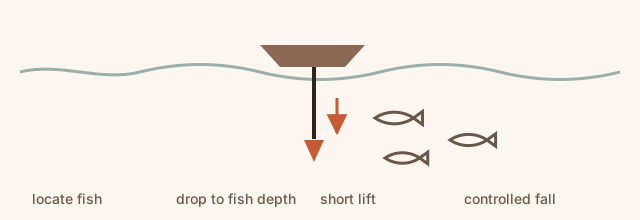
Do not automatically drop to bottom when fish are suspended.
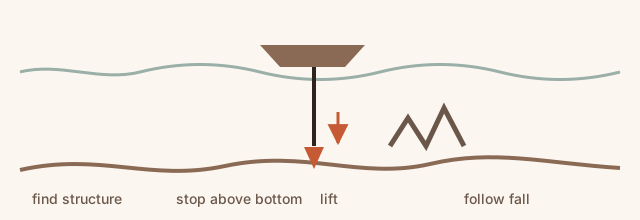
Maintain enough line control to detect bites on the drop.
On the water
Boat position and line angle usually matter as much as lure color. Start with the situation that matches your water, then make one adjustment at a time.
Start: Lower to bottom and lift enough to avoid debris
Adjust: Add weight only when drift requires it
Watch for: Hard impacts can wedge the lure in brush
Start: Stop at the fish depth rather than dropping to bottom
Adjust: Try short lifts and controlled pauses
Watch for: Fast falls move the lure below the school
Start: Position upwind or upstream of the target
Adjust: Correct boat position instead of fishing a long diagonal
Watch for: Respect boating and anchoring restrictions
Where to fish
How to fish
Target differences
This section describes how anglers may apply the method to different fish. The source-backed lake connections counted above are limited to Crappie, Hybrid striped bass, Striped bass, White bass in the published database. A species discussed below is not automatically verified for every lake on this page.
Stop the lure at the depth of the school. Dropping beneath suspended fish is one of the easiest ways to miss them.
Keep compact jigs just above fish around brush, timber and bridge structure when the technique is source-backed for that water.
Vertical presentations can work on deep structure or suspended fish when casting would spend too much time outside the target zone.
Rod, reel, line and rigging
Seasonal guide
Water temperature, wind, lake level and fish position change how a method works. Use the seasonal starting points below alongside current reports and local access conditions.
Spring
Useful when fish stage deeper before or after shallow movements.
Summer
A strong option for deep schools and offshore structure.
Fall
Effective around concentrated bait and schooling fish.
Winter
Often one of the most precise ways to target tightly grouped deep fish.
Common mistakes
Verified lake coverage
Start with these 6 Texas lake examples. Each links to water-specific target species and seasonal information. All 52 covered lakes are listed below; check local access, fishing rules and recent reports before traveling.
Browse all Texas fishing lake guides → to compare additional waters.
Lake guide
Jigging spoons are among TPWD's documented presentations during Amistad's white-bass spawning run.
Target species
Lake guide
Vertical spoons and live-shad presentations are useful when hybrids are located beneath the boat.
Target species
Lake guide
Vertical spoons are one of the established open-water approaches for Lake Livingston striped bass.
Target species
Lake guide
Slabs, spoons and vertical presentations fit Tawakoni's schooling open-water fisheries.
Target species
Lake guide
Jigs and small moving baits fit the spring white-bass spawning run.
Target species
Lake guide
Jigs, spoons and slabs fit Possum Kingdom's white-bass and striped-bass schooling patterns.
Target species
Choose a lake to see its species, seasonal information and access notes. The presence of a method here is not a prediction of current fishing conditions.
Current conditions
Before fishing with vertical jigging, check your setup and the conditions on the water.
Review dated fishing reports and archives, bait and fishing regulations, weather, access and water conditions before a trip.
Keep exploring
Compare presentations that solve a nearby problem instead of treating one technique as the answer for every depth, cover type or fish position.
Cover more water when fish are scattered rather than concentrated below the boat.
Open technique guide →Hold natural bait at a precise depth when fish are visible on sonar.
Open technique guide →A closely related depth-control approach for crappie and cover-oriented fish.
Open technique guide →Read the lake
Learn how points, humps, creek channels, ledges, roadbeds, brush, timber and docks fit together as fishing targets.
Read the structure guide →Read the habitat
Understand submerged grass, emergent plants, floating cover, flooded terrestrial vegetation and the edges fish use.
Read the vegetation guide →Practical questions
Use enough weight to stay controlled and nearly vertical in the current depth, wind and current without making the presentation unnecessarily heavy.
No. Many open-water fish suspend. Match the lure depth to the fish, not automatically to the lake bottom.
Fish often strike as the lure drops, so excessive slack can hide the bite. A controlled fall keeps the lure natural while preserving contact.
Sources
Compiled by the Texas Defined editorial team from cited TPWD reservoir descriptions and the linked fishing lake records. The original comparisons distinguish published findings from editorial interpretation and practical planning advice. They are not independent field tests, proof of an active bite, or a substitute for current regulations and notices. Each lake guide retains its own source trail. Read our editorial policy, source methodology or request a correction.
Checked 2026-08-13
Open official/source page ↗Checked 2026-08-15
Open official/source page ↗Checked 2026-08-13
Open official/source page ↗Checked 2026-08-13
Open official/source page ↗Checked 2026-09-23
Open official/source page ↗Checked 2026-09-23
Open official/source page ↗Checked 2026-08-15
Open official/source page ↗