
Skip to content

Trolling technique

How to Troll for Fish in Texas

Trolling presents one or more baits behind a moving boat so anglers can cover open water, maintain depth and intercept roaming fish.

Lake Texoma reservoir water and shoreline as seen from Eisenhower State Park in Texas
Lake Texoma, a Texas reservoir where TPWD documents striped-bass trolling. Landscape photograph, not a trolling demonstration. GrapevineTxOnline.com / Wikimedia Commons · CC BY 2.0. · Photo source · License terms

Lake guides

37

Lake-linked species

3

Species documented in this method’s linked lake records

Seasonal scope

All year

This method has a year-round lake record, not a daily catch forecast

A Texas example from the source record

What Lake Conroe Tells Us

What Texas Parks & Wildlife documents

TPWD describes open-water trolling as a common way Lake Conroe anglers catch hybrid striped bass.

Read the TPWD reservoir guide ↗

How to use that information

Locate the fish and bait before selecting lure depth. A consistent line length and boat speed make repeated passes comparable; adding lines before controlling the first lure makes diagnosis harder.

The documented Conroe example is for hybrid striped bass. It does not establish black-bass trolling for every reservoir or promise a current bite.

Compare two actual Texas waters

Conroe hybrids and Texoma stripers require different searches

Open-water trolling works only when the target species and the lure's actual running depth agree. These two fisheries illustrate why the target comes first.

Lake Conroe

Documented by TPWD: TPWD identifies trolling open water as a common way anglers target hybrid striped bass; the upper river has standing timber that can become a navigation hazard.

Planning decision: Look for open-water bait and fish before setting a repeatable, modest lure spread. Avoid treating an upper-river timber route as a normal open-water trolling lane.
Lake Texoma

Documented by TPWD: TPWD notes that striped bass can be caught by trolling deep-running lures near main-lake river-channel flats after their spring spawning run.

Planning decision: Use channel proximity and marked fish to choose a pass, then change one variable at a time: speed, line length or lure depth.

What changes your first cast?

Write down the first successful or unsuccessful pass as boat speed, line length, approximate target depth and location. Repeat it before changing several variables together.

Hybrid striped bass at Conroe and striped bass at Texoma are different targets. This is not a live fish location or permission to ignore boating, gear or water-specific restrictions.

Texas Defined editorial analysis based on linked Texas Parks & Wildlife reservoir guides. These are comparisons of published fishery descriptions, not firsthand trip reports or evidence of today's catch. TPWD pages reviewed 2026-11-13; the date is not a current fishing report.

When to use

When to Use Trolling

When striped, hybrid or other open-water fish are scattered.

When fish are following creek channels, river channels or bait schools.

When covering large reservoirs efficiently matters.

When depth control is more important than repeated casting.

Texas rules

Check Legal Devices and Water-Specific Rules

Trolling itself is common, but rod, line, hook, species and water-body rules can vary.

  • Check the current Texas Outdoor Annual before fishing, especially when using multiple rods, hooks or multi-bait systems.
  • Special limits and border-water rules can apply on individual reservoirs.
  • Do not treat a technique page as a substitute for current species, license or water-body regulations.
Texas Parks & Wildlife — current fishing regulations ↗

Choose the setup

Choose a Trolling Approach

Depth control is the central problem. Speed, lure design, line length and any added weight must work together.

Diving lureShallow–deep by lureFollowing contour lines, points, channel edges and suspended fish
Weighted line / sinker-assistedMid-depth–deepHolding a bait below its natural running depth
Umbrella / multi-bait presentationVariableOpen-water baitfish imitation where legal and practical
Slow natural-bait trollVariableOpen-water fish that are following forage but not responding to fast artificials

Trolling at a glance

Build a Repeatable Trolling Pass

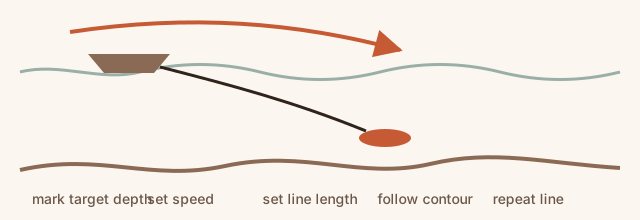
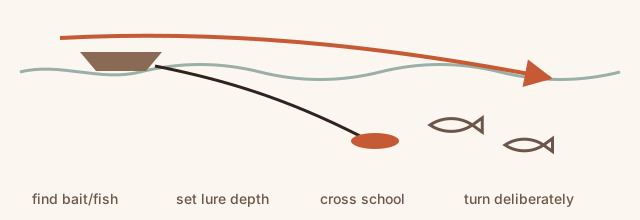
A productive pass is a measured combination of boat path, speed and lure depth—not simply driving while a lure trails behind.

Contour pass
Boat following a contour while a diving lure runs at a controlled depth
mark target depth
set speed
set line length
follow contour
repeat productive line

Repeatability lets you test one variable at a time.

Suspended-fish pass
Trolled lure crossing a school of suspended fish at the target depth
find bait/fish
set lure depth
cross school
turn deliberately

Inside and outside lines change speed and depth during turns.

On the water

Build a controlled trolling pass

Use one-variable-at-a-time speed and depth changes, not speculative catch claims. Start with the situation that matches your water, then make one adjustment at a time.

Channel edges

Start: A contour-following route with a manageable legal spread

Adjust: Change lure depth before adding lines

Watch for: Watch restricted zones and submerged hazards

Suspended fish

Start: A pass informed by sonar and lure running depth

Adjust: Vary speed or line length separately

Watch for: Line length does not guarantee exact depth

Wind or heavy traffic

Start: A route prioritizing boat handling and visibility

Adjust: Reduce lines or abandon an unsafe pass

Watch for: Do not cross busy ramps or swimmers

Where to fish

Where to Troll for Fish

  1. Channel edges and bends.
  2. Open-water flats near bait.
  3. Main-lake points and humps.
  4. Areas where sonar shows suspended fish or bait.

How to fish

How to Troll for Fish

  1. Use speed, lure choice and line length together to control depth.
  2. Make turns deliberately because inside and outside lines change speed and depth.
  3. Mark productive passes and repeat the same contour rather than wandering randomly.
  4. Keep lures clear of debris because one fouled bait can waste an entire pass.

Target differences

Trolling by Fishery

The verified lake links above focus on the fish recorded in the fishing catalog. The black-bass note below explains another possible use; it is not a verified black-bass trolling entry for each linked lake.

This section describes how anglers may apply the method to different fish. The source-backed lake connections counted above are limited to Hybrid striped bass, Striped bass, White bass in the published database. A species discussed below is not automatically verified for every lake on this page.

Striped and hybrid bass

Use electronics and bait location to set the target depth rather than trolling an arbitrary contour.

White bass

Smaller profiles and repeatable passes can work around schooling fish and channel-oriented movement.

Black bass — general technique note

Contouring points and creek channels can be a presentation option where local fisheries guidance supports it. Do not treat that as a source-backed black-bass trolling claim for every linked lake.

Rod, reel, line and rigging

Basic Tackle and Rigging Setup

Rod holders and a consistent spread improve repeatability.
Match tackle to the species and lure resistance.
Use depth-capable electronics or contour information where available.
Follow all current Texas regulations governing rods, lines and species-specific limits.

Seasonal guide

Season-by-Season Guide

Water temperature, wind, lake level and fish position change how a method works. Use the seasonal starting points below alongside current reports and local access conditions.

Spring

Follow open-water fish as they transition between river influence and the main lake.

Summer

Especially useful for suspended fish holding over deep water.

Fall

Track bait concentrations and temperature-driven movement.

Winter

Slower speeds and precise depth control can become more important.

Common mistakes

Common Mistakes to Avoid

  • Trolling without a target depth.
  • Making productive passes once instead of repeating them.
  • Ignoring speed changes during turns.
  • Failing to monitor for fouled lures.

Verified lake coverage

Texas Lakes Covered in This Guide

Start with these 5 Texas lake examples. Each links to water-specific target species and seasonal information. All 37 covered lakes are listed below; check local access, fishing rules and recent reports before traveling.

Browse all Texas fishing lake guides → to compare additional waters.

Browse all 37 lakes for trolling (alphabetical)

Choose a lake to see its species, seasonal information and access notes. The presence of a method here is not a prediction of current fishing conditions.

Current conditions

Check Current Conditions Before You Fish

Before you troll, check your setup and the conditions on the water.

  • Check the applicable waterbody's trolling and boating rules, marked hazards and current lake level before selecting a route.
  • Use depth information and observed forage or fish position to set the target zone; avoid choosing a lure solely by its advertised maximum depth.
  • Account for wind, boat speed and traffic when planning safe, repeatable passes.

Review dated fishing reports and archives, bait and fishing regulations, weather, access and water conditions before a trip.

Keep exploring

Compare presentations that solve a nearby problem instead of treating one technique as the answer for every depth, cover type or fish position.

Practical questions

Trolling Questions, Answered

How do I know how deep a trolled lure is running?

Use the lure's known diving behavior as a starting point, then control speed, line length, line diameter and added weight consistently. Electronics help confirm where fish are relative to the presentation.

Why repeat the same trolling pass?

Repeating a productive line helps separate a real depth or structure pattern from a one-off encounter.

What changes during a turn?

The outside line speeds up while the inside line slows down, which can change both lure action and running depth.

Sources

Sources and Verification

Compiled by the Texas Defined editorial team from cited TPWD reservoir descriptions and the linked fishing lake records. The original comparisons distinguish published findings from editorial interpretation and practical planning advice. They are not independent field tests, proof of an active bite, or a substitute for current regulations and notices. Each lake guide retains its own source trail. Read our editorial policy, source methodology or request a correction.