texas history
USS Lexington (CV-16): The Blue Ghost, World War II Aircraft Carrier and Corpus Christi Museum
The complete story of USS Lexington: 1942 launching, Pacific combat, postwar jet-era and training-carrier service, preservation on Corpus Christi's North Beach, and practical museum hours, tickets, accessibility and photographs.
USS Lexington (CV-16), nicknamed the Blue Ghost, is not a battleship. She is an Essex-class aircraft carrier whose World War II aircraft attacked targets hundreds of miles from the ship, whose deck operated fighters and bombers, and whose service lasted until 1991. Today the carrier is preserved on North Beach in Corpus Christi, where visitors can explore selected spaces from the flight deck to exhibits inside the hull. She provides the strongest direct comparison to Battleship Texas (BB-35): a different weapon, a different mission, and a different preservation story.
A crucial naming distinction: CV-16 was not the famous earlier aircraft carrier USS Lexington (CV-2), sunk at the Battle of the Coral Sea in May 1942. The new Essex-class carrier was originally intended to be named Cabot, but it received the Lexington name after CV-2 was lost. Nor was either Lexington a U.S. warship named Texas. We connect them because together they explain the shift from gun-centered sea power to aviation.
At a glance: the three Texas-connected museum and history ships
- USS Texas (1895–1911): a second-class/pre-dreadnought battleship; fought during the Spanish–American War; renamed San Marcos; not preserved for visiting.
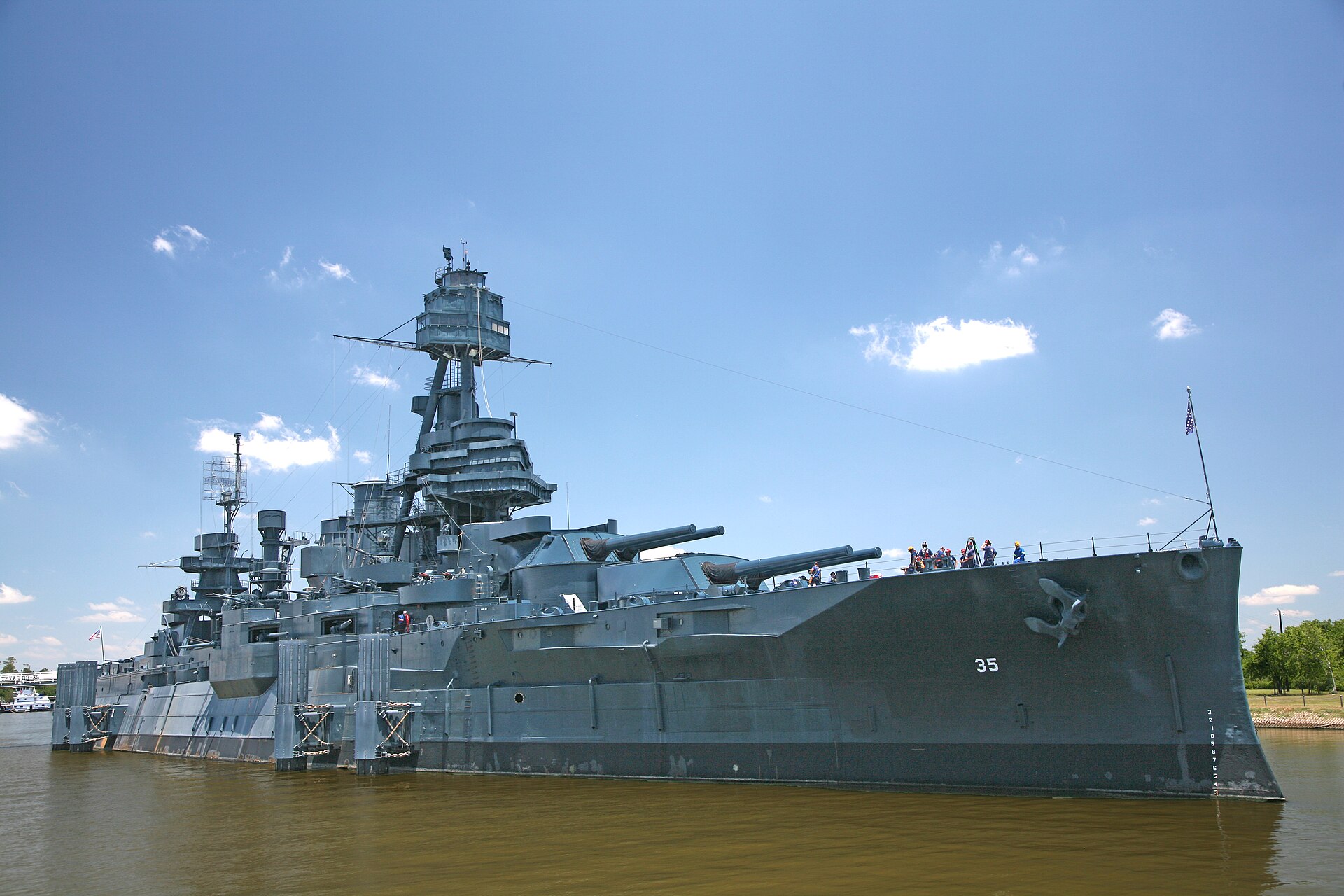
- USS Texas (BB-35, 1914–1948): a dreadnought battleship that served in both World Wars; preserved and currently CLOSED for routine tours during restoration at Gulf Copper in Galveston; planned future museum at Pier 15.
- USS Lexington (CV-16, 1943–1991): an Essex-class fleet aircraft carrier; Pacific War and later Navy training service; open as a museum on North Beach in Corpus Christi (check operator hours before traveling).
1941–1943: a new aircraft carrier gets a famous name
The Navy laid the keel of the future CV-16 at the Fore River Shipyard in Quincy, Massachusetts, during 1941. Launched on September 26, 1942, the ship was commissioned on February 17, 1943. She belonged to the mass-produced Essex class, a principal instrument of American naval air power across the Pacific.
The carrier was originally laid down as Cabot. After Lexington (CV-2) was lost at Coral Sea, the Navy transferred that honored name to CV-16. It is a rare instance where confusing ships with the same name can change the interpretation of a whole campaign: the 1942 Lexington loss belongs to CV-2; the carrier visible in Corpus Christi and the great 1944–45 fast-carrier operations belong to CV-16.

Why the aircraft carrier changed naval warfare
A battleship such as BB-35 put its fighting power into armored hulls and turret guns. A fleet carrier used fighters, dive bombers and torpedo planes to strike aircraft, shipping and targets ashore far beyond the reach of a battleship's guns. The carrier was therefore both a moving airfield and an intricate refueling, armament, aviation-maintenance and command system.
That difference changed strategy, logistics and the lives of sailors. Lexington needed flight-deck crews, aviation gasoline, aircraft mechanics, bomb and torpedo handlers, fire and damage control teams, and a command organization coordinating flight cycles. Battleships still provided valuable shore bombardment and protection, but the fleet carrier became the main long-range strike platform.

1943–1945: combat in the Pacific
Lexington joined the Pacific carrier force in 1943 and took part in successive fast-carrier raids and island campaigns. Her aircraft helped project U.S. air power across the central and western Pacific, including operations connected with the Gilberts, Marshalls, Marianas and later Philippine and Japanese approaches. Rather than treating a list of battles as the entire story, the central development was the emergence of sustained aircraft operations from a mobile seagoing base.
The June 1944 Marianas operations, including the Battle of the Philippine Sea, demonstrated the strength of U.S. carrier air groups and pilot training against Japan's naval air forces. Lexington was among the carriers whose squadrons contributed to that campaign.


The Blue Ghost nickname
The ship's museum recounts Japanese reports of Lexington being sunk repeatedly, even though the carrier returned to action after attacks and repairs. The museum associates the nickname 'Blue Ghost' with that reputation, wartime naval camouflage and Tokyo Rose broadcasts. Because popular retellings of radio propaganda often conflate several voices and later memories, the nickname is best attributed to the museum's historical tradition rather than presented as a verbatim surviving broadcast quotation.
During World War II, Lexington's aircraft and gunners served in dangerous operations far from the ship's home shores. The human story includes pilots killed on missions, deck personnel working around propellers and ordnance, and sailors who fought fires and damage. A carefully captioned photograph of the ship's flight deck should be read as a record of those working conditions, not only of military equipment.
Why Lexington was not the same kind of ship as Battleship Texas
BB-35's primary offensive weapons were ten 14-inch guns and its wartime assignment repeatedly involved firing on coastal positions to support troops landing ashore. CV-16 launched aircraft for reconnaissance, interception and strikes across a far wider radius. The ships' combat histories overlap chronologically in 1944–45 but not in purpose: Lexington participated in carrier strikes in the Pacific while Texas supported amphibious operations from North Africa and Normandy to Iwo Jima and Okinawa.
This contrast is why a TexasDefined naval-history network should not call Lexington a battleship merely because it is a giant Navy museum ship. Naming the difference improves research accuracy and lets a reader decide which experience matters most.
From combat carrier to jet-era and training carrier
Lexington briefly left active service after World War II, then returned in the 1950s with modernized equipment and capabilities reflecting the jet age. She served in the fleet before becoming a principal Navy training carrier based at Pensacola. Her longevity allowed generations of naval aviators to practice the demanding procedures required for carrier takeoffs and landings.


1991–1992: preservation in Corpus Christi
The Navy decommissioned Lexington on November 26, 1991. Corpus Christi successfully worked to preserve the carrier, which arrived in the area in January 1992, was transferred for museum use and moved into its permanent North Beach berth. The museum opened to the public in October 1992. Preserving a working aircraft carrier meant caring for an enormous, complex steel ship and converting areas designed for military operations into interpretive and visitor spaces.
Lexington was recognized as a National Historic Landmark in 2003. Its significance goes beyond a single combat engagement: it embodies both World War II fleet-carrier design and four decades of technological adaptation and aircrew training.

Plan a visit to USS Lexington: 2026 hours and prices
The museum operator's published schedule, reviewed October 14, 2026, lists 9 a.m.–5 p.m. during the season from Labor Day to Memorial Day and 9 a.m.–6 p.m. in summer. The museum generally opens seven days a week except Thanksgiving Day and Christmas Day. Admission tickets are sold at the entrance booths on the day of the visit; standard admission is not marketed as a general online ticket.
- Address: 2914 N. Shoreline Boulevard, Corpus Christi, Texas 78402, on North Beach.
- 2026 published general admission: adults (18+) $25; seniors (60+) $21; military $16 with ID; ages 13–17 $20; ages 4–12 $15; children 3 and under free.
- Published all-day visitor parking: $5 (members free). The museum notes a 3% processing surcharge on non-cash transactions.
- The flight and hangar decks are listed as wheelchair accessible, with a LEX LIFT elevator between them; much of the ship's historic machinery and passageway system includes steep ladders and restricted access.
- Check the operator's current hours-and-admission page for updated prices, closures, holiday events or accessibility changes before traveling.
What to see aboard: plan your time around the ship
Start with the flight deck for the most immediate sense of carrier scale. Its aircraft displays and open sky help explain the long runway required for takeoff and arresting-gear landings at sea. In hot or windy weather, do this portion earlier in the day; the deck is exposed.
The hangar deck and museum exhibits add the human side: aircraft maintenance, navigation and command, damage control, crew living areas and special exhibitions. The ship also promotes a 3D theater, Pearl Harbor exhibit and other visitor activities. Not every compartment is wheelchair accessible; the museum expressly identifies the hangar and flight decks as accessible and describes the elevator connecting them.
Allow several hours for an unhurried visit, and choose closed-toe shoes with good grip. Visitors with a disability or medical mobility concerns should ask the museum directly which decks and exhibit zones they can reach; an accessible main route does not imply that every original Navy ladder has been replaced.
A practical North Beach day in Corpus Christi
Lexington sits beside the Texas State Aquarium. For a focused family day, choose one attraction for the morning and the other after lunch, keeping an eye on the museum's closing time and time spent walking. Downtown Corpus Christi, the bayfront and the marina district are nearby but across the Harbor Bridge corridor, so plan that transfer rather than assuming it is the same stroll as North Beach.
For a longer Coastal Bend trip, add Padre Island National Seashore on another day. It is not adjacent to the aircraft carrier, and beach-road closures, weather and summer heat require different planning from a museum visit.
Frequently asked questions
- Is USS Lexington a battleship? No. CV-16 is an Essex-class aircraft carrier. Battleship Texas BB-35 is a separate museum ship in restoration at Galveston.
- Is this the ship sunk at Coral Sea in 1942? No. That was an earlier carrier, USS Lexington CV-2. The museum ship CV-16 was commissioned in 1943.
- Is the Lexington museum open? The operator currently lists regular daily museum hours, excluding Thanksgiving and Christmas, subject to current notices.
- Can visitors with wheelchairs board? The operator states that the flight and hangar decks are accessible using the LEX LIFT, but not every historic ship space is accessible.
- Are tickets sold online? The operator states that ordinary museum admission is purchased at its admission booths; event/escape-room tickets can differ.
- Is the USS Texas in Corpus Christi? No. BB-35 is undergoing restoration at Gulf Copper in Galveston. The preserved carrier Lexington is in Corpus Christi.
Sources, reuse rights and update policy
The USS Lexington Museum's original-history, admission and visitor pages are the authoritative sources for operating claims and museum facts. The National Park Service provides independent National Historic Landmark context. All historic photographs above use individually named Wikimedia Commons files from Navy collections; the Corpus Christi aerial photograph is attributed to Matthew T Rader under CC BY-SA 4.0 and has not been intentionally modified. Check each Commons file for source, license and full-resolution alternatives.
Admission, opening hours, parking, accessibility and visitor routes were checked against the museum's official pages on October 14, 2026 and should be reviewed at least every 14 days. The historical guide should also receive a longer-term evidence review when new naval research is published.
Image credit: U.S. Navy photograph 80-G-236932 · Public domain · Wikimedia Commons
Primary source: USS Lexington Museum on the Bay ↗
Sources and further reading
- USS Lexington Museum — ship's service history and specifications ↗
- USS Lexington Museum — museum and preservation history ↗
- USS Lexington Museum — hours, admissions, parking and accessibility (checked 2026-10-14) ↗
- National Park Service — National Historic Landmark interpretation ↗
- Historic CV-16 photographs, individual image rights and dates ↗
- Museum-era photograph categories and creator rights ↗
Plan Your Visit
Places connected to this story
Destinations explicitly tied to this article in the Texas Defined guide.
Corpus Christi · Nueces County
USS Lexington Museum
The World War II Essex-class aircraft carrier USS Lexington (CV-16), preserved on Corpus Christi's North Beach as a National Historic Landmark and aviation museum.
Updated Oct 2026- World War II aircraft carrier
- Flight deck aircraft
- Wheelchair-accessible hangar and flight decks with LEX LIFT
Corpus Christi · Nueces County
Texas State Aquarium
A major Gulf Coast aquarium in Corpus Christi focused on marine life, coastal habitats and wildlife conservation, with indoor galleries, large tanks and family exhibits on North Beach.
Updated Aug 2026- Gulf of Mexico marine life
- Large aquatic habitats
- Wildlife presentations
Galveston · Galveston County
Battleship Texas
Commissioned in 1914, USS Texas (BB-35) is the world's only surviving dreadnought-era battleship and a veteran of both World Wars, now undergoing a $75 million restoration and museum overhaul in Galveston for a permanent home at Pier 15.
Best season: Not currently open for regular tours; plan for the announced 2027 grand-reopening target only after confirming current Foundation updatesUpdated Oct 2026- Current shipyard berth: Gulf Copper, Galveston (no normal walk-up boarding)
- Current shoreline view: Pier 21, per the Battleship Texas Foundation
- Only surviving dreadnought-era battleship
Fredericksburg · Gillespie County
National Museum of the Pacific War
The Fredericksburg museum is devoted to the Pacific Theater of World War II and grew from the hometown story of Fleet Admiral Chester W. Nimitz. Its scale makes it a destination in its own right rather than a quick museum stop; allow enough time for galleries, artifacts and outdoor exhibits.
Updated Aug 2026- World War II
- Chester Nimitz
- military museums



From the magazine
More stories to read next
Then & Now
El Camino Real de los Tejas in Texas: Historic Trail, Sites and Visiting Guide
October 17, 2026 · About 4 minutes
Then & Now
Butterfield Overland National Historic Trail in Texas: Where to Visit and What Survives
October 17, 2026 · About 3 minutes