texas history
The First USS Texas (1895–1911): Spanish–American War Battleship and San Marcos
Before the surviving Battleship Texas BB-35, a different USS Texas fought at Santiago de Cuba in 1898. Discover the original ship's unusual design, people, service, renaming, gunnery-test wreck, and surviving archival images.
There have been two dramatically different U.S. Navy battleships named Texas. The one that visitors recognize today—the New York-class USS Texas (BB-35), commissioned in 1914 and now being restored in Galveston—was the second. The first USS Texas was launched in 1892, commissioned in 1895, fought in the Spanish–American War, and ended her career as the target ship San Marcos. Confusing their photographs, campaigns or end dates collapses twenty years of naval transformation into one imaginary vessel. This guide keeps them separate.
The original Texas was an early American steel battleship, designed when governments were still experimenting with how to combine armor, heavy guns, cruising ability and steam machinery. She was built at the Norfolk Navy Yard in Virginia, not in Texas. Her association with the state came from her name and later commemoration, rather than Texas shipbuilding. She is also not a visitable museum: the historic ship was sunk in Chesapeake Bay during ordnance testing in 1911.
Quick identification: which USS Texas?
- First USS Texas: launched June 28, 1892; commissioned August 15, 1895; second-class steel battleship; Spanish–American War veteran; renamed San Marcos in February 1911; expended as a gunnery target.
- Second USS Texas (BB-35): launched May 18, 1912; commissioned March 12, 1914; New York-class dreadnought battleship; served in both World Wars; decommissioned in 1948; survives as Battleship Texas in the Galveston restoration program.
- Neither ship served in the independent Republic of Texas Navy of the 1830s and 1840s. That was a separate navy operating decades before the U.S. battleships.

1886–1895: the Navy tries to design a modern battleship
Congress authorized the vessel in the 1880s, as the United States began rebuilding a fleet that lagged behind modern armored ships abroad. Construction started at Norfolk on June 1, 1889. The ship was launched on June 28, 1892, and commissioned on August 15, 1895, with Captain Henry Glass as her first commanding officer. The ship's sponsor, Madge Houston Williams, connected the naming ceremony with Texas memory.
Texas displaced about 6,315 tons and measured roughly 309 feet in length, a relatively compact ship by the standards of the later all-big-gun battleships. Her principal armament consisted of two 12-inch guns in single turrets placed diagonally—one to port and one to starboard rather than in the centered line of twin turrets familiar from BB-35. The ship also carried smaller guns, armored protection and coal-fired steam machinery. The layout reflected serious experimentation about fields of fire, blast effects and ship stability.
She is often described as the Navy's first battleship, but context matters: the designation reflects the emerging generation of steel-hulled purpose-built American battleships and her commissioning chronology, not a claim that the United States had never owned heavily armed ironclads. The contemporary armored cruiser Maine, later sunk at Havana in February 1898, was part of this same phase of naval modernization, although the two vessels were not identical sister ships.

An awkward design, accidents and the 'Old Hoodoo' nickname
The first Texas was celebrated as a new-generation steel warship, yet her early service exposed problems with construction, handling and mechanical systems. The nickname 'Old Hoodoo' is associated with a run of mishaps and a reputation for bad luck. Stories about her accidents should not overshadow her later combat contribution; the same difficult ship that prompted ridicule would be part of a major U.S. naval victory in 1898.
Her diagonal battery created complicated arcs of fire and placed blast stresses on the ship, illustrating why later designs moved toward more practical main-battery arrangements. Keeping the engineering context in view is useful: the ship was not simply a failed BB-35, but a product of an earlier set of technological assumptions.
1898: blockade duty and the Spanish–American War
After the destruction of USS Maine at Havana and the outbreak of war in April 1898, Texas served in Cuban waters with American naval forces. The Navy's historical record places her off Cienfuegos for blockade operations from May 21 and then around Santiago de Cuba and Guantánamo Bay. On June 16, Texas joined the cruiser Marblehead in shelling a fort at Cayo del Tore near Guantánamo.
Naval blockade was more than a pause between battles. By restricting movements and supplies, U.S. warships affected Spain's ability to maintain the fleet and troops in Cuba. Texas's presence also illustrates the deployment limitations of the era: coal, machinery reliability, gunnery and communication shaped what warships could actually do at sea.

July 3, 1898: Battle of Santiago de Cuba
The first Texas's defining engagement occurred when Admiral Pascual Cervera's Spanish squadron attempted to break out from Santiago harbor on July 3, 1898. The American blockading fleet opened fire, and Texas joined the battle, directing her heavy weapons against Spanish armored cruisers while her secondary guns joined the action against smaller vessels. The result was the destruction or surrender of the Spanish squadron.
That victory effectively ended Spain's ability to challenge U.S. naval power around Cuba and became a defining American sea battle of the war. Texas was one member of a fleet operation; giving her exclusive credit would be as misleading as omitting her entirely. Her combat service also overturned the easy assumption that an experimental or accident-prone design necessarily lacked wartime value.
When reading older battle accounts, pay attention to ship names: the armored cruiser Infanta María Teresa, the cruisers Vizcaya and Cristóbal Colón, and the destroyers Plutón and Furor belonged to the Spanish side. Several U.S. ships participated in defeating them. The Navy's historical summary lists the vessels engaged by Texas and describes the combined action.

The crew and daily life at sea
The photograph of an armored warship tells only part of its history. Crews shoveled and hauled coal, tended boilers and engines, maintained guns and ammunition, steered, navigated and kept communications operating with technology very different from modern radio-equipped vessels. Work in confined machinery spaces and hot gun compartments was physically demanding, with routine preventive maintenance essential to every voyage.
Naval History and Heritage Command preserves images of the Texas crew, including sailors assembled by heavy guns and even photographs featuring shipboard animal mascots. These human details matter because the ship's service cannot be understood as a story of tonnage and armor alone.

After the war: Atlantic service, station duties and obsolescence
Texas continued operations in the western Atlantic after the war and served as flagship of the Coast Squadron during part of the 1902–1905 period. From 1908 she was used as a station ship at Charleston, South Carolina. These roles were less glamorous than the 1898 battle but reflect the ordinary ways navies use aging ships: training, coastal duties, presence and support.
At the same time battleship design rapidly moved away from the compromises of the 1880s. Larger ships could carry more armor, stronger machinery and increasingly standardized heavy batteries. The original Texas belonged to the era before HMS Dreadnought entered service in 1906; the later BB-35 belonged to the dreadnought generation. Their difference is not only one of size but of naval strategy and industrial technology.
1911: renamed USS San Marcos to free the Texas name
On February 11, 1911, the Navy renamed the first Texas San Marcos so that the state's name could be assigned to the new Battleship No. 35 under construction. This is the crucial bridge between the two histories: despite sharing a name, they were distinct hulls with separate crews, specifications, wars and fates. The first Texas never fought at Normandy; BB-35 never fought at Santiago de Cuba.
San Marcos was stricken from the Navy List in October 1911. That year, the Navy used the obsolete ship as a gunnery target in Chesapeake Bay. The Naval History and Heritage Command's March 1911 photographs show canvas target screens erected aboard her, damage from shots fired by USS New Hampshire, and the battered hull settling on the bottom. Later accounts refer to the remaining wreck as a hazard and to further testing or removal work. The decisive fact is that the first Texas was not preserved as a museum.

Where is the original USS Texas today?
The original ship is a historic wreck associated with Chesapeake Bay ordnance testing, not a public attraction in Texas. Its remains do not belong to the museum site at Galveston. There are no ordinary visitor tours or admission tickets for the 1895 ship. For photographs, plans and documentary interpretation, use the U.S. Navy's ship history and Naval History and Heritage Command photo collections linked below.
Some retellings disagree on exactly which later tests or demolition operations 'sank' the already damaged hull. The safest evidence-based wording separates the heavily documented 1911 gunnery test and sinking/grounding of the target from subsequent work on the wreck, rather than assigning every late event to one dramatic day.
What remains—and what historians can still study
Surviving archival photographs depict Texas underway, at anchor, coaling, before and after the 1898 battle, and in damaged target-ship condition. Navy image catalog numbers such as NH 63506, NH 61227 and NH 73106–NH 73111 help researchers distinguish original primary photographs from copied postcards, later illustrations and mislabeled internet pictures.
Plans reveal the unusual diagonal turret placement and industrial design. Contemporary news images show how Americans understood the war and the new battleship program. The best historical reconstruction places these sources alongside the Navy's service chronology, rather than treating modern captions as unquestionable primary evidence.
Visitor and research questions
- Can you visit this USS Texas in Galveston? No. The ship being restored in Galveston is BB-35, commissioned in 1914. The first Texas is not a museum.
- Was the first Texas a dreadnought? No. It belongs to the earlier second-class/pre-dreadnought design era.
- Did the first ship fight in World War I or II? No. Its combat record is associated with the Spanish–American War in 1898.
- Why the San Marcos name? The Navy renamed the old Texas in 1911 to reuse Texas for Battleship No. 35.
- Can historical photographs be reused? Some U.S. Navy government-produced imagery is public domain, but check each image's Commons/NHHC source record and any separate photographer or collection restrictions.
Further reading, sources and photo credits
The Naval History and Heritage Command's first-Texas page provides commissioning, 1898 engagements and the 1911 rename. Its dedicated image index contains numbered photographs for publication-quality documentary use. The Norfolk Naval Shipyard history confirms construction heritage. The U.S. Naval Institute adds detailed naval-architecture and 'Old Hoodoo' context; use it with attribution and do not reproduce its prose.
Each inline photograph is credited by its originating archival collection, with the full individual license record accessible through its Wikimedia Commons file page. Historic photos may be public domain while modern scans, paintings or private reconstructions carry separate rights. The source links above are the audit trail. Facts were checked October 14, 2026; this history is comparatively stable and should be reverified at least annually and after major newly published archival scholarship.
What changed after the battleship era? USS Lexington
The naval-design progression does not end with the dreadnought. USS Lexington (CV-16), an Essex-class aircraft carrier commissioned in 1943 and now preserved as a museum in Corpus Christi, carried aircraft rather than battleship turrets as its central offensive weapon. Compare the pre-dreadnought Texas's unusual turret layout with BB-35's centerline guns and Lexington's flight deck to see the changing relationship of technology, distance and sea power. Lexington is not a third battleship named Texas; it is an important separate preserved naval vessel in the state.
Continue to the surviving Battleship Texas
If your goal is a future visit, the surviving ship is USS Texas (BB-35), commissioned in 1914. Our separate Battleship Texas restoration guide follows two world wars, San Jacinto museum history, the ongoing work in Galveston and the planned Pier 15 museum. The Battleship Texas Foundation currently reports that routine tours are closed and targets 2027 for the new museum opening.
Image credit: U.S. National Archives · NARA 512957 · Public domain · Wikimedia Commons
Primary source: Naval History and Heritage Command ↗
Sources and further reading
- Original USS Texas circa 1900 hero photograph — NARA 512957, public-domain Commons file record ↗
- Naval History and Heritage Command — the first Texas, service and history ↗
- U.S. Navy — photographs of Texas (1895–1911) ↗
- Naval Sea Systems Command — Norfolk shipyard history ↗
- U.S. Naval Institute — Old Hoodoo and target-ship history ↗
- Texas State Historical Association — Texas, battleship ↗
- Historic photographs with individual creator and reuse records ↗
Plan Your Visit
Places connected to this story
Destinations explicitly tied to this article in the Texas Defined guide.
Galveston · Galveston County
Battleship Texas
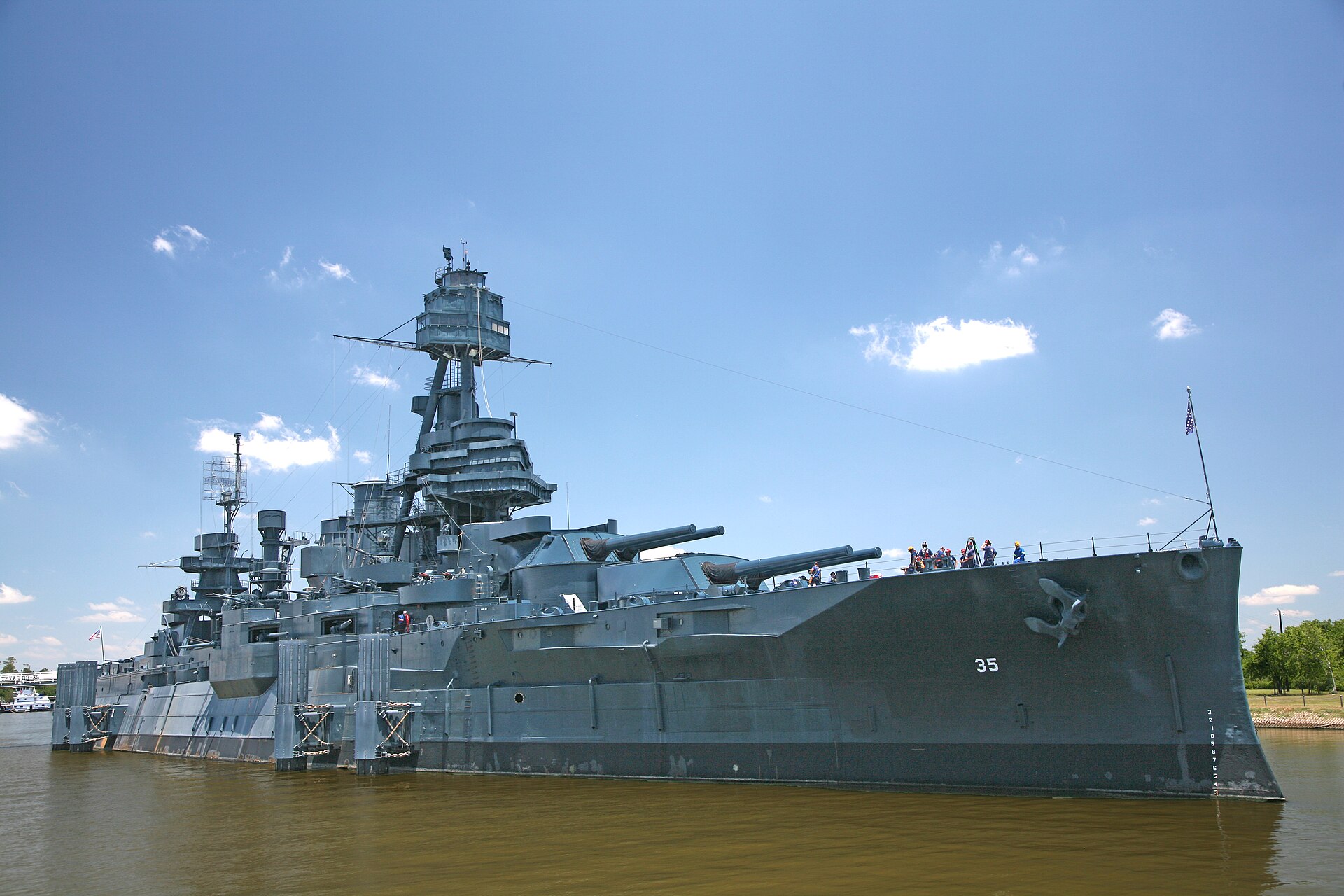
Commissioned in 1914, USS Texas (BB-35) is the world's only surviving dreadnought-era battleship and a veteran of both World Wars, now undergoing a $75 million restoration and museum overhaul in Galveston for a permanent home at Pier 15.
Best season: Not currently open for regular tours; plan for the announced 2027 grand-reopening target only after confirming current Foundation updatesUpdated Oct 2026- Current shipyard berth: Gulf Copper, Galveston (no normal walk-up boarding)
- Current shoreline view: Pier 21, per the Battleship Texas Foundation
- Only surviving dreadnought-era battleship
La Porte · Harris County
San Jacinto Battleground State Historic Site
The Houston Ship Channel battlefield where the Texian army defeated Santa Anna's forces on April 21, 1836, interpreted through the landscape, museum collections and the towering San Jacinto Monument.
Best season: Fall through spring for comfortable walking across the exposed battlefieldUpdated Oct 2026- San Jacinto Monument
- 1836 battlefield landscape
- San Jacinto Museum

From the magazine
More stories to read next
Then & Now
El Camino Real de los Tejas in Texas: Historic Trail, Sites and Visiting Guide
October 17, 2026 · About 4 minutes
Then & Now
Butterfield Overland National Historic Trail in Texas: Where to Visit and What Survives
October 17, 2026 · About 3 minutes