
County Guide
Gillespie County
German settlement, granite country, the Pedernales River, presidential history, ranch roads and modern wine country meet in one of the Texas Hill Country's most layered counties.
- Guide type
- Texas county guide
- County seat
- Fredericksburg, Texas
- Source check
- Official source checked
- Last reviewed
- August 4, 2026
Verified county profile
What the data says about Gillespie County
The 2020 Census counted 26,725 residents across about 1,058 square miles of land. Dividing those two Census figures gives roughly 25.3 residents per square mile.
Census geography also records about 3 square miles of water. Water represents approximately 0.3% of the county's mapped land-and-water area.
Fredericksburg is the verified county seat.
Texas Defined does not add an unsourced list of local communities. Additional places appear here only when the structured place directory contains a verified county relationship.
Understand the bigger picture
These Texas Explained guides add statewide context to the geography, settlement and infrastructure behind Gillespie County.
Explore Texas Explained →Historic places in this county
History you can visit in Gillespie County
Texas Defined currently connects 6 historic destinations to this county guide.
Statewide context
Where Gillespie County sits in the county data
These ranks use the same Texas State Library and U.S. Census county dataset as the statewide comparison. A rank is shown only when that metric is available for the county and the comparison set; missing source values are excluded rather than estimated.
- 2020 population
- #99
- of 254 counties with source data
- land area
- #57
- of 254 counties with source data
- population density
- #115
- of 254 counties with source data
- water share
- #176
- of 254 counties with source data
Seasonal planning
Best times to visit Gillespie County
Use current seasonal reports and statewide planning guides before building a trip around wildflowers, fall color or holiday events. Conditions and event dates can change from year to year.
Property tax rates
Taxing units in Gillespie County
Texas property taxes are imposed by separate local taxing units. The table below lists finalized statewide records associated with Gillespie County. A district appearing here does not mean every property in the county pays that district; use the exact parcel record to determine jurisdiction.
Checking finalized local tax rates…
Made, built & born here
Texas products and companies tied to this county
Texas Defined separates products actually made or processed locally from companies that were founded, headquartered or operate major facilities here.
Made or processed here
Fischer & Wieser
Fredericksburg
Hill Country specialty-food producer known for sauces, preserves and jellies.
Verified source: Fischer & Wieser ↗Headquartered here
Circle E Candles
Fredericksburg
Circle E is headquartered and ships from Fredericksburg; its site says its candles are U.S.-manufactured but does not establish Texas production.
Made or processed here
Altstadt Brewery
Fredericksburg
German-style brewery in the Fredericksburg area.
Verified source: Altstadt Brewery ↗Manufacturing footprints change. A Texas headquarters or founding city is not presented as proof that every current product is made in Texas.
Browse the statewide Made in Texas guide →Painted Churches
Painted Churches in Gillespie County
Our statewide Painted Churches collection includes 1 church in Gillespie County. This guide connects its local history, architecture, decorative arts, preservation, and immigrant heritage to the broader story of Texas Painted Churches.
At a glance
The county in numbers
- County seat
- Fredericksburg, Texas
- 2020 population
- 26,725
- Land area
- 1,058 sq. mi.
- Water area
- 3 sq. mi.
- Population density
- 25.3 / sq. mi.
- Water share
- 0.3%
County questions
Quick answers about Gillespie County
What is the county seat of Gillespie County?
Fredericksburg, Texas is the county seat of Gillespie County.
How many people live in Gillespie County?
The 2020 U.S. Census counted 26,725 residents in Gillespie County.
How densely populated is Gillespie County?
Using the 2020 Census population and Census land-area figure, Gillespie County has about 25.3 residents per square mile. This is a derived density figure, not a separate Census estimate.
What cities and communities are in Gillespie County?
Gillespie County includes communities such as Fredericksburg. City limits, mailing addresses and county boundaries do not always match, so verify an exact address when county jurisdiction matters.
Where do I look up property taxes in Gillespie County?
TexasDefined has not yet published a county-specific property-tax guide for Gillespie County because its local source verification is still incomplete. Use the statewide county property-tax directory and the official local office links on this page while verification is pending.
How do I research industries and employers around Gillespie County?
Start with the Texas industries hub to understand the statewide sector system, then use Made in Texas and local sources to verify which companies and facilities are actually tied to Gillespie County. TexasDefined does not treat a statewide industry page as proof that a specific employer operates in this county.
How do I find official Gillespie County government information?
Start with the official Gillespie County website for county departments, services, courts and records. For property values, exemptions and protests use the appraisal district; for tax bills and payments use the office designated by the taxing unit. TexasDefined links to the statewide property-tax county directory until this county-specific tax guide passes source verification.
Property taxes
County property-tax resources
Property-tax questions in Gillespie County involve several separate authorities. Until the county-specific tax guide passes source verification, use the statewide county property-tax directory plus the official appraisal and tax-office resources shown here.
Property & county services
Official local resources
Property appraisal
The Comptroller directory entry is undated or more than two years old. This guide does not display potentially outdated individual contact details. Follow the official county directory link to verify the current office.
Comptroller office listing updated 2017-09-07; confirm contact details with the district before visiting.
Tax office
Tax assessor-collector: Carol Rode Durst
Phone: 830-997-6519
101 W. Main St., Unit 2 Fredericksburg, Texas 78624-3700
Comptroller office listing updated 2025-03-25; confirm vehicle and tax service details with the office before visiting.
County feature
The story of Gillespie County
Gillespie County: Fredericksburg, Stonewall and a Hill Country Crossroads
German settlement, granite country, the Pedernales River, presidential history, ranch roads and modern wine country meet in one of the Texas Hill Country's most layered counties.
Published August 11, 2026 · 9 min read
Gillespie County sits where several versions of the Texas Hill Country overlap. Fredericksburg gives the county its best-known face: limestone buildings, German names, a broad Main Street and a tourism economy built around history, food, shops and wine. But the county stretches far beyond town. Stonewall follows the Pedernales River through peach orchards, ranches and the country that shaped Lyndon B. Johnson. Doss and Harper hold onto the scale of rural western Gillespie County. To the northeast, granite begins to interrupt the limestone landscape on the approach to Enchanted Rock. Taken together, these places make Gillespie County less a single destination than a compact map of Hill Country history.
A landscape divided by limestone, granite and the Pedernales
Most of Gillespie County lies on the Edwards Plateau, where shallow soils, limestone hills, live oak, Ashe juniper and open grassland favor ranching more naturally than row-crop agriculture. The northeastern corner reaches toward the Llano Uplift, where much older igneous rock comes to the surface. That geologic transition is visible at Enchanted Rock, whose pink granite domes were formed from magma that cooled far underground roughly a billion years ago and were exposed by immense spans of erosion. The Pedernales River cuts across the southern part of the county, gathering creeks that drain the uplands before the river continues east toward the Colorado River system.
That mix of rock, water and thin soil helped determine how the county developed. Farms clustered where bottomland soils and reliable water made cultivation practical; sheep, goat and cattle operations spread across rougher country; roads followed valleys and passes through the hills. Even today, the most memorable drives in Gillespie County are often the roads between places rather than the places alone: ranch fences, limestone outcrops, creek crossings, vineyards, peach stands and old schoolhouses appear in quick succession.
Fredericksburg began as a German colonization project
European settlement accelerated in 1846 when John O. Meusebach led about 120 German immigrants sponsored by the Adelsverein to the site that became Fredericksburg. The settlers were part of a larger effort to establish German communities in Texas and ultimately reach the Fisher-Miller Land Grant farther west. Fredericksburg developed quickly enough that residents petitioned the Texas Legislature for a new county in late 1847. On February 23, 1848, the state created Gillespie County from parts of Bexar and Travis counties, named it for Mexican War officer Robert A. Gillespie and designated Fredericksburg as the county seat.
The town's original plan still helps explain its character. Settlers received town lots and nearby agricultural tracts, producing a settlement pattern that tied Main Street to farms outside town. The Vereins Kirche served early residents as a church, school and public gathering place. German remained widely spoken for generations, and architecture, church traditions, family names, foodways and community organizations carried that immigrant history forward even as Fredericksburg became more closely connected to the rest of Texas.
The Meusebach-Comanche agreement changed the frontier
Settlement west of Fredericksburg depended on relations with Native peoples who already used the region. In 1847 Meusebach and a delegation traveled into Comanche territory and negotiated an agreement with Comanche leaders including Buffalo Hump and Santa Anna. The Meusebach-Comanche Treaty allowed German settlers to travel and survey in the San Saba country while recognizing reciprocal access and establishing procedures for reporting wrongdoing. The agreement opened millions of acres to surveying and settlement and became one of the defining episodes in the German-Texan story. It also belongs to the larger, more complicated history of Indigenous homelands and nineteenth-century expansion in Central and West Texas.
Fort Martin Scott placed Fredericksburg on the military frontier
The United States Army established Fort Martin Scott east of Fredericksburg in 1848, the same year the county was organized. The post belonged to the chain of frontier forts created as migration and military activity moved west. Soldiers patrolled routes, escorted travelers and operated in a region where civilian settlements, Indigenous nations and expanding federal power met. The fort also mattered economically: soldiers purchased goods and services in Fredericksburg, giving the young town another market beyond agriculture.
Fort Martin Scott was active as a U.S. Army post from 1848 to 1853, later served Texas Rangers and briefly came under Confederate control during the Civil War. The surviving and reconstructed site is now operated by the Texas Historical Commission. Its original guardhouse, archeological remains and interpretive buildings make the fort one of the clearest places to understand why Fredericksburg grew where it did and how quickly this immigrant settlement became connected to the wider western frontier.
The Civil War exposed a deep local divide
Gillespie County's German population did not move in lockstep with the rest of Confederate Texas. Many residents opposed secession, and wartime coercion fell heavily on Union loyalists in the Hill Country. In 1862 a group attempting to reach Mexico was pursued by Confederate forces and attacked near the Nueces River. The deaths associated with the Battle of the Nueces and the later execution of wounded prisoners became a lasting trauma in German-Texan communities. Fredericksburg's Treue der Union monument commemorates men who died for Union loyalty and preserves a Civil War memory that differs sharply from the narrative found in many other Texas counties.
That history matters because it shows how ethnicity, migration, local politics and national conflict intersected in the Hill Country. Gillespie County's political identity for much of the late nineteenth and twentieth centuries was unusually Republican for Texas, a pattern historians connect in part to the county's German community and its Civil War experience.
Stonewall links farm life to presidential history
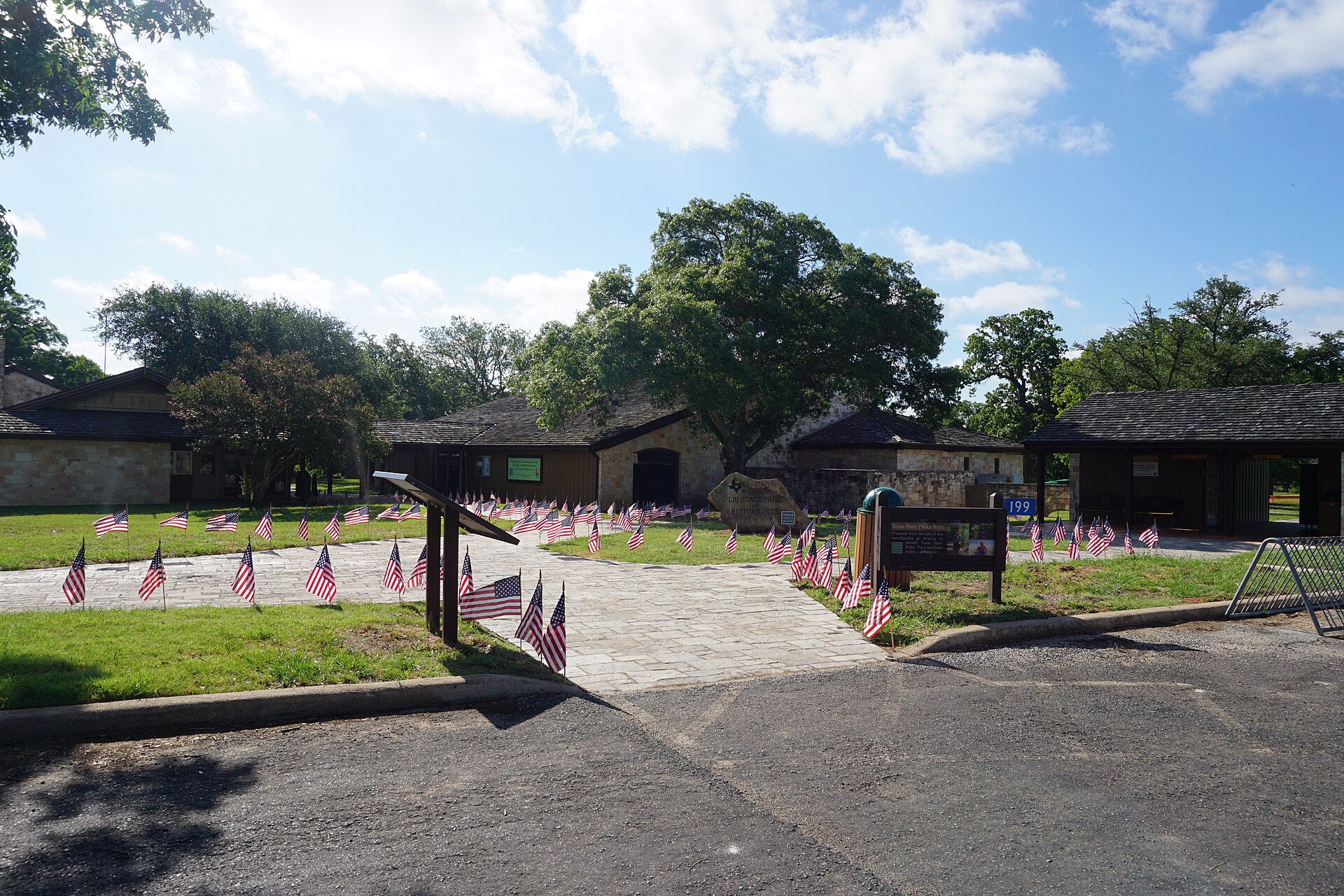
East of Fredericksburg, Stonewall occupies the Pedernales River valley where orchards, farms and ranches have long used the deeper soils along the river corridor. The area became nationally significant through Lyndon B. Johnson, who was born nearby and later made the LBJ Ranch one of the most consequential political landscapes in Texas. The ranch district of Lyndon B. Johnson National Historical Park lies in Gillespie County and includes Johnson's reconstructed birthplace, the Junction School, the family cemetery, ranch buildings, cattle pastures, airstrip and the Texas White House complex.
Johnson repeatedly returned to the ranch while president and conducted government business there, making the Pedernales valley an extension of the White House during the 1960s. Across the river, Lyndon B. Johnson State Park & Historic Site interprets a broader Hill Country story. The Sauer-Beckmann Living History Farm presents German-Texan farm life around 1918, while historic cabins, longhorns, bison and the river landscape connect presidential history to the rural world that surrounded Johnson from childhood.
Rural schools and communities preserve another side of the county
Fredericksburg dominates the county's population and visitor economy, but Gillespie County developed as a network of rural communities. Stonewall, Harper, Doss, Luckenbach, Willow City, Albert, Crabapple, Cave Creek and other settlements grew around churches, schools, stores, mills, ranches and road junctions. Some became tourism names; others remain small clusters of houses and community institutions. Their scale helps explain why rural education was so important. National Park Service interpretation at Junction School notes that Gillespie County once had 31 one-room schools, built close enough to farm and ranch families that children could reach them without traveling to Fredericksburg.
Doss offers one of the clearest examples of that continuity. Its school tradition survived long after many rural districts elsewhere in Texas consolidated. The county's historic schoolhouses, cemeteries and churches also preserve German-language inscriptions and family histories outside the better-known museum district in Fredericksburg.
Peaches, ranching and wine all grow from the same rural economy
For trip planning, treat the wine industry as a network rather than one attraction. The Fredericksburg destination hub and the dedicated wineries-and-things-to-do guide separate downtown tasting rooms from Highway 290 properties and Stonewall/Hye-area estates, while linking current official winery sources. That structure lets the county page explain why wine belongs here without turning a county-history article into a commercial directory.
Agriculture has changed without disappearing. Sheep, goats and cattle became important across the county's rougher uplands, while the Pedernales corridor and other pockets of deeper soil supported crops and orchards. Gillespie County peaches became a regional identity of their own, especially around Stonewall, where roadside stands still signal the summer harvest. In more recent decades vineyards and wineries have added another agricultural layer along U.S. 290 and surrounding roads.
The wine industry changed the county's visitor geography. Fredericksburg remains the commercial center, but tasting rooms, production facilities, vineyards, lodging and restaurants now stretch east toward Stonewall and beyond. That growth sits alongside older ranches and orchards rather than replacing them completely. The result can look contradictory: a working agricultural county and a high-demand leisure destination sharing the same narrow highways and groundwater systems. Understanding modern Gillespie County means seeing tourism and land use as part of the same story.
Enchanted Rock marks the county's ancient edge
North of Fredericksburg, Enchanted Rock rises at the Gillespie-Llano county line as one of Texas's most recognizable natural landmarks. Texas Parks and Wildlife describes the main dome and surrounding granite features as the exposed remains of magma that cooled deep underground about a billion years ago. The natural area contains hundreds of protected archeological sites, evidence that people used this landscape long before German settlement. Hiking across the bare granite, visitors can see thin soils, weathered boulders, vernal pools and plant communities adapted to an environment that differs sharply from the limestone country only a short drive away.
Enchanted Rock also illustrates the conservation pressures that come with the Hill Country's popularity. The original state natural area opened in 1978 after conservation action protected the property from development, and the state has continued acquiring nearby land. For Gillespie County, the landmark is both a natural resource and a reminder that scenery itself has become economically valuable.
Fredericksburg became a destination without losing its local institutions
Tourism did not arrive from nowhere. Fredericksburg had long served travelers because of its position on westbound routes, and nineteenth-century hotels, stores and freight activity gave Main Street a commercial purpose early. Today the historic core supports museums, restaurants, galleries, lodging and retail, while institutions such as the Pioneer Museum, the National Museum of the Pacific War and historic churches interpret different parts of the county's past. The Admiral Nimitz connection is especially local: Fleet Admiral Chester W. Nimitz was born in Fredericksburg, and the museum complex grew from the historic Nimitz Hotel associated with his family.
The town's popularity can make it easy to treat Fredericksburg as a themed version of German Texas. The county is more interesting than that. Its German heritage is real, but so are the Indigenous history that preceded settlement, the military frontier, Unionist memory, Mexican American labor and community life, presidential politics, ranching, agriculture and the environmental limits of a fast-growing visitor economy.
How to read Gillespie County today
A useful way to experience Gillespie County is to move outward from Fredericksburg rather than staying only on Main Street. Fort Martin Scott explains why the town mattered on the frontier. Ranch roads north reveal the transition toward granite country and Enchanted Rock. U.S. 290 east passes orchards, vineyards and Stonewall before reaching the LBJ state and national historic sites along the Pedernales. Roads west toward Harper and northwest toward Doss show a quieter ranching landscape where distances widen and the tourism corridor falls away.
That movement makes the county's defining pattern visible: Gillespie County has repeatedly absorbed new layers without fully erasing the old ones. German farmsteads sit near wineries; a presidential ranch remains a working cattle landscape; a frontier fort survives inside a modern tourism economy; rural schoolhouses stand within reach of one of Texas's busiest small-town destinations. The county's appeal comes from those overlaps. Fredericksburg may be the front door, but the full Gillespie County story is written across the hills, river bottoms, ranch roads and communities beyond it.
Sources & verification
Research and official records
Research references support the editorial history and places described above. The official directories below help verify current county seats, census geography, property tax offices and vehicle services. Office personnel, contact details and links can change; check the agency website before traveling.
A claim-by-claim county-specific source list has not yet been published for this guide. The official starting points below are not a substitute for documented historical research.
Further county history research
Use the published county history as independent background reading, not as proof that every claim in this guide has been checked against that reference.
Town and local attraction guides
Explore Gillespie County in more depth
Explore these independent town guides for history, primary-source links, area attractions, trip timing, access considerations and nearby places. Town boundaries and regional side trips are distinguished from the county itself.
- Fredericksburg
Locally researched history, travel logistics, attractions, itineraries and primary visitor sources.
Museum and heritage guides
Museums connected to Gillespie County
Independent guides to collections, exhibits, visitor planning, accessibility and historical research. Verify each museum's current hours and admissions before traveling.
- National Museum of the Pacific War
Fredericksburg, Gillespie County · Exhibits and visitor planning
Explore this county
State parks in Gillespie County
Visit-ready local park guides with official maps, facilities research and nearby trip ideas. Review current park alerts and reservations before setting out.
A massive pink-granite dome north of Fredericksburg with nearly 21 miles of hiking, a famous summit climb, rock climbing, stargazing and a newly opened backcountry trail system.
A free Texas state park and living-history site on the Pedernales River near Stonewall, centered on the Sauer-Beckmann Farm, German-Texan farm life, bison and longhorns, historic cabins and the gateway into the adjacent LBJ Ranch district.
Local places to visit
More to explore in Gillespie County
These additional local places complement the park, museum, beach and other destination guides on this county page. They are not ranked. For events, swimming, tours or restricted properties, always check current visitor information before traveling.
- History & heritage
LBJ Ranch at Stonewall
Lyndon B. Johnson National Historical Park ranch visitor area near Stonewall; obtain the required free driving permit and check current building access.
RV parks & campgrounds
RV camping around Gillespie County
TexasDefined currently connects 6 RV park or campground directory entries to this county. Verify hookups, rig limits, rates and reservations with the operator before travel.
- Fredericksburg KOA HolidayFredericksburg, Texas
- Fredericksburg RV ParkFredericksburg, Texas
- Lady Bird Johnson Municipal ParkFredericksburg, Texas
- Oakwood RV ResortFredericksburg, Texas
- Texas Wine Country RV ResortFredericksburg, Texas
- Vineyards RV ParkFredericksburg, Texas
Major annual events
Events worth planning around in Gillespie County
Texas Defined links only to event guides backed by organizer or equivalent first-party evidence. Future recurrence-derived dates are labeled on the event guide.
Texas tournaments
Tournaments & competitions near Gillespie County
Browse TexasDefined’s statewide tournament directory across golf, rodeo, team sports, fishing, BBQ, chess, esports, academic competitions and more. County relationships are published only when a location can be assigned confidently; current dates, venues and entry details require organizer verification.
Texas horse racing
Horse racing in Gillespie County
Live horse-racing venues, inactive track histories and statewide regulatory or horsemen organizations based in this county. Offices are not visitor racetracks.
Texas high school football
High school football in Gillespie County
See current UIL football programs whose TEA school-directory records are in Gillespie County. Use the statewide finder to compare a specific high school or ISD before choosing where to live.
Open the statewide football finder →Loading current UIL football programs…
What this tells you: current 2026–28 UIL classification, football division, district and six-man/11-man format. School, ISD, city and county context is attached only when Texas Education Agency AskTED produces an unambiguous campus match; uncertain matches are deliberately omitted.
All-time state-final history: title and appearance totals use UIL’s Football All-Time Appearances table, supplemented with newer completed state-final rows from the official State Archives when that all-time table trails the latest archive. Totals appear only on an exact normalized UIL school-name match.
Recent state-final detail: the game-level list covers the eight completed UIL championship seasons from 2018–19 through 2025–26. No history badge does not mean a weak program; it means the source did not produce an exact normalized school-name match.
This is not a “best school” rating. Football placement and recent championship history are only parts of researching a program. Attendance zones, transfers, eligibility and campus assignments can change, so confirm an exact address and student eligibility with the school district and UIL before making a move.