
Current on channel edges
Start: A legal cut-bait piece on a controlled bottom rig
Adjust: Use enough weight to hold without sweeping into cover
Watch for: Check line abrasion and snag risks
Bait technique
Cut bait uses pieces of a legally obtained bait fish to release scent and oils for catfish. In Texas, the source fish matters as much as the rig: game fish or any part of a game fish may not be used as bait, and water-specific bait rules can be more restrictive.

Lake guides
68
Lake-linked species
3
Species documented in this method’s linked lake records
Seasonal scope
All year
This method has a year-round lake record, not a daily catch forecast
When to use
For blue catfish where fresh cut forage is an established reservoir or river presentation.
For channel catfish when a compact natural bait can be placed along channels, flats, points or current.
When current or wind can carry scent through a travel lane instead of leaving the bait in stagnant water.
When fish are roaming along channel edges, tributary mouths, wind-blown flats or other forage routes.
When a fresh legal bait source is available and can be kept cold, firm and usable.
Texas rules
Legality starts with the source fish, not with how it is cut. Check the current Outdoor Annual before keeping or cutting any fish for bait.
Choose the setup
Only start with a fish that is legal to use as bait. Then match the cut, hook placement and overall bait size to the target fish, current and presentation.
Rigging at a glance
These simplified layouts show component order, not exact leader lengths or sinker sizes. Adjust weight and tackle to depth, current, cover and target fish.
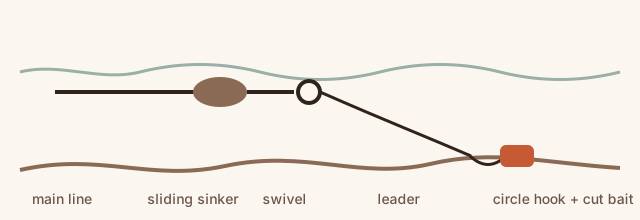
A strong general-purpose layout for bottom-oriented catfish.
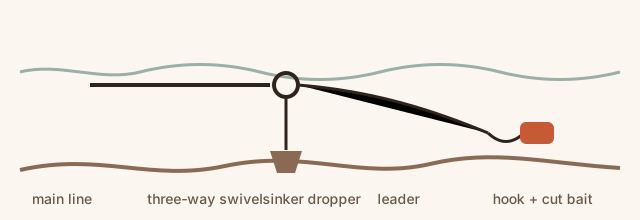
Separates the sinker and bait when current control matters.
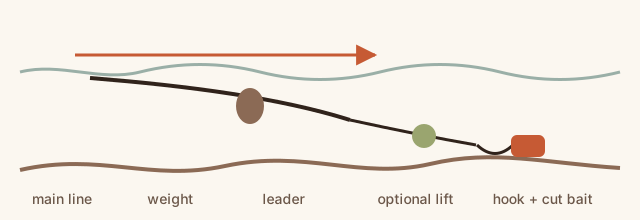
Keeps the bait moving or slightly off bottom when drifting or fishing over soft debris.
On the water
Texas prohibits using game fish or any part of a game fish as bait. Start with the situation that matches your water, then make one adjustment at a time.
Start: A legal cut-bait piece on a controlled bottom rig
Adjust: Use enough weight to hold without sweeping into cover
Watch for: Check line abrasion and snag risks
Start: A suspended presentation at measured depth
Adjust: Change depth before automatically increasing bait size
Watch for: Do not obstruct navigation
Start: A simple rig that can be retrieved and refreshed
Adjust: Replace bait when needed
Watch for: Dispose of unused bait lawfully
Where to fish
How to fish
Target differences
Do not collapse every catfish into one bait rule. Their feeding behavior and the most practical natural-bait presentation differ.
This section describes how anglers may apply the method to different fish. The source-backed lake connections counted above are limited to Blue catfish, Catfish, Channel catfish in the published database. A species discussed below is not automatically verified for every lake on this page.
Fresh cut bait is a core starting point on many Texas reservoirs. Focus on forage, channels, flats, current seams and seasonal travel routes rather than soaking bait in featureless water.
Smaller cut pieces can be practical around channels, points, flats and current. Match tackle to the fishery rather than automatically using trophy-catfish gear.
Flatheads are commonly associated with live-bait presentations and structure. Cut bait can catch them, but do not treat the blue-catfish playbook as interchangeable with flathead fishing.
Rod, reel, line and rigging
Seasonal guide
Water temperature, wind, lake level and fish position change how a method works. Use the seasonal starting points below alongside current reports and local access conditions.
Spring
Rising temperature, tributary influence and seasonal movement can pull catfish toward inflows, channel edges and adjacent flats. Follow current forage and water movement rather than assuming every shallow area is productive.
Summer
Low-light and nighttime periods can improve shallow opportunities, while daylight fish may use deeper channels, ledges or current. Heat also makes bait handling and keeping cut bait cold more important.
Fall
Cooling water and forage movement can concentrate feeding fish along creek channels, flats and transition routes. Cover water until bait and fish location become repeatable.
Winter
Large blue catfish can become an important target on many reservoirs. Deep channels, channel edges and forage concentrations are more useful starting points than a generic 'deep water' rule.
Common mistakes
Verified lake coverage
Start with these 5 Texas lake examples. Each links to water-specific target species and seasonal information. All 68 covered lakes are listed below; check local access, fishing rules and recent reports before traveling.
Browse all Texas fishing lake guides → to compare additional waters.
Lake guide
Cut bait is a documented Choke Canyon approach for blue and channel catfish.
Target species
Lake guide
Natural and cut baits remain established year-round Falcon catfish methods.
Target species
Lake guide
Cut and other natural baits fit the lake's channel-oriented blue and channel catfish fishery.
Target species
Lake guide
Cut bait is one of TPWD's established Tawakoni catfish approaches.
Target species
Lake guide
Cut bait is one of TPWD's recommended catfish presentations on Possum Kingdom.
Target species
Choose a lake to see its species, seasonal information and access notes. The presence of a method here is not a prediction of current fishing conditions.
Current conditions
Before fishing with cut bait, check your setup and the conditions on the water.
Review dated fishing reports and archives, bait and fishing regulations, weather, access and water conditions before a trip.
Keep exploring
Compare presentations that solve a nearby problem instead of treating one technique as the answer for every depth, cover type or fish position.
Use natural movement instead of scent-driven cut bait where legal and appropriate.
Open technique guide →A contrasting open-water search method when fish are roaming rather than holding to channels or current.
Open technique guide →A precise alternative when fish are concentrated below the boat instead of moving through a scent line.
Open technique guide →Read the lake
Learn how points, humps, creek channels, ledges, roadbeds, brush, timber and docks fit together as fishing targets.
Read the structure guide →Read the habitat
Understand submerged grass, emergent plants, floating cover, flooded terrestrial vegetation and the edges fish use.
Read the vegetation guide →Practical questions
Start with fresh, legally obtained local forage or other lawful nongame bait that matches what catfish are feeding on. The best choice varies by reservoir, river and current forage, so legality and local food base come before a universal bait name.
No. Texas prohibits using a game fish or any part of a game fish as bait. Always verify the current Outdoor Annual because bait and water-specific rules can change.
Fresh bait is the preferred baseline because it preserves scent, oils and texture well, but properly handled frozen bait can still be useful. Replace pieces that become washed out, mushy or no longer stay securely on the hook.
Pass the hook through firm skin or tissue while keeping the hook point and gap exposed. Clear scales away from the point so the bait does not block penetration.
There is no statewide timer. If a high-percentage channel edge, flat, current seam or travel route shows no activity, reposition rather than assuming a longer soak will create fish that are not there.
Sources
Compiled by the Texas Defined editorial team from cited TPWD reservoir descriptions and the linked fishing lake records. The original comparisons distinguish published findings from editorial interpretation and practical planning advice. They are not independent field tests, proof of an active bite, or a substitute for current regulations and notices. Each lake guide retains its own source trail. Read our editorial policy, source methodology or request a correction.
Checked 2026-08-13
Open official/source page ↗Checked 2026-10-05
Open official/source page ↗Checked 2026-09-23
Open official/source page ↗Checked 2026-08-13
Open official/source page ↗Checked 2026-09-23
Open official/source page ↗Checked 2026-08-15
Open official/source page ↗